
- [방문 감사합니다] (970)

| 일 | 월 | 화 | 수 | 목 | 금 | 토 |
|---|---|---|---|---|---|---|
| 1 | 2 | 3 | ||||
| 4 | 5 | 6 | 7 | 8 | 9 | 10 |
| 11 | 12 | 13 | 14 | 15 | 16 | 17 |
| 18 | 19 | 20 | 21 | 22 | 23 | 24 |
| 25 | 26 | 27 | 28 | 29 | 30 | 31 |
- Effectiveness Coaching
- 원하는 결과
- 코치올
- 씽킹 파트너
- 이종서 HR 컨설턴트
- 이종서 코치
- 효과성 코칭 모델
- Coach Sukjae Lee
- 관점 코칭
- 결정적 행동
- 생각 파트너 이석재
- 효과성 코칭
- 미위마인드 mewemind.com
- 경영심리학자의 효과성 코칭
- 3S-FORM Coaching Model
- 관점 전환
- 효과성 코칭 방법론
- 현장중심 코칭심리학
- Effectiveness Coaching Model
- 떠도는 마음 사용법
- 코칭심리학 공부방
- 실행력을 높이는 코칭심리학 수업
- 3S-FORM Coaching Model과 뇌과학의 결합
- Sukjae Lee Ph.D.
- thinking partner
- 코칭방법론
- 현징증심 코칭심리학
- 멘탈 모델링 코칭
- Effectiveness Coaching Methodology
- 증거기반코칭
- Today
- Total
생각 파트너
MEWEMIND: An Ontological Reconsideration of Mental Modeling 본문
MEWEMIND: An Ontological Reconsideration of Mental Modeling
Thinking Partner 2026. 2. 4. 19:41MEWEMIND: An Ontological Reconsideration of Mental Modeling
— Human Beings as Relational from the Beginning
Sukjae Lee, Ph.D.
Creator of the Effectiveness Coaching Methodology
Feburary 4, 2026
Abstract
Despite the proliferation of sophisticated change models in coaching, leadership, and organizational development, sustainable transformation remains elusive. This paper argues that such failures stem not from methodological inadequacy, but from an implicit ontological assumption that positions human beings as fundamentally separate and self-contained individuals. Drawing on relational ontology, systems thinking, and collective sensemaking literature, this conceptual paper introduces MEWEMIND as a descriptive framework that articulates human beings as inherently relational from the outset. MEWEMIND reframes mental modeling not as a cognitive technique for reframing thoughts, but as an ontological recall of relational being. By situating individual reframing, team restructuring, and organizational reconstruction within this ontological ground, the paper offers a unifying foundation for more sustainable psychological and collective change. Implications for coaching practice, team dynamics, and organizational transformation are discussed.
Keywords
MEWEMIND; mental modeling; relational ontology; systems thinking; collective sensemaking; coaching psychology; organizational change
1. The Ontological Premise Preceding Mental Models
Theories of change typically begin with epistemic inquiries concerning assumptions, interpretations, and cognitive frames (Argyris & Schön, 1978; Senge, 1990). While these approaches have advanced understanding of learning and adaptation, they often presuppose a deeper, unexamined layer.
Prior to cognition, an ontological orientation is already operative—namely, an implicit answer to the question: What kind of being am I? This orientation functions less as explicit belief and more as a pre-reflective mode of self-perception (Heidegger, 1962).
In many contemporary organizational contexts, the dominant ontological premise implicitly frames individuals as isolated, self-responsible units. From this premise, mental models naturally converge toward competition, defense, efficiency, and optimization (Ghoshal & Bartlett, 1999). These orientations are not ethical shortcomings but logical consequences of an atomistic ontology.
2. MEWEMIND as Ontological Discovery
MEWEMIND is proposed not as a normative ideal nor as a socially constructed value system, but as a descriptive recognition of relational being. This position aligns with relational ontologies that conceptualize human existence as fundamentally constituted through relationships rather than as pre-social individuality (Buber, 1958; Gergen, 2009).
The inversion from ME to WE signifies not a cognitive reframing alone, but an ontological reorientation. Importantly, MEWEMIND does not negate individuality; instead, it suggests that when individuality is examined at its deepest experiential level, relationality is already present.
Thus, WE is neither the outcome of consensus nor the product of institutional design. It is an ontological condition that precedes social contracts and organizational structures (Emirbayer, 1997).
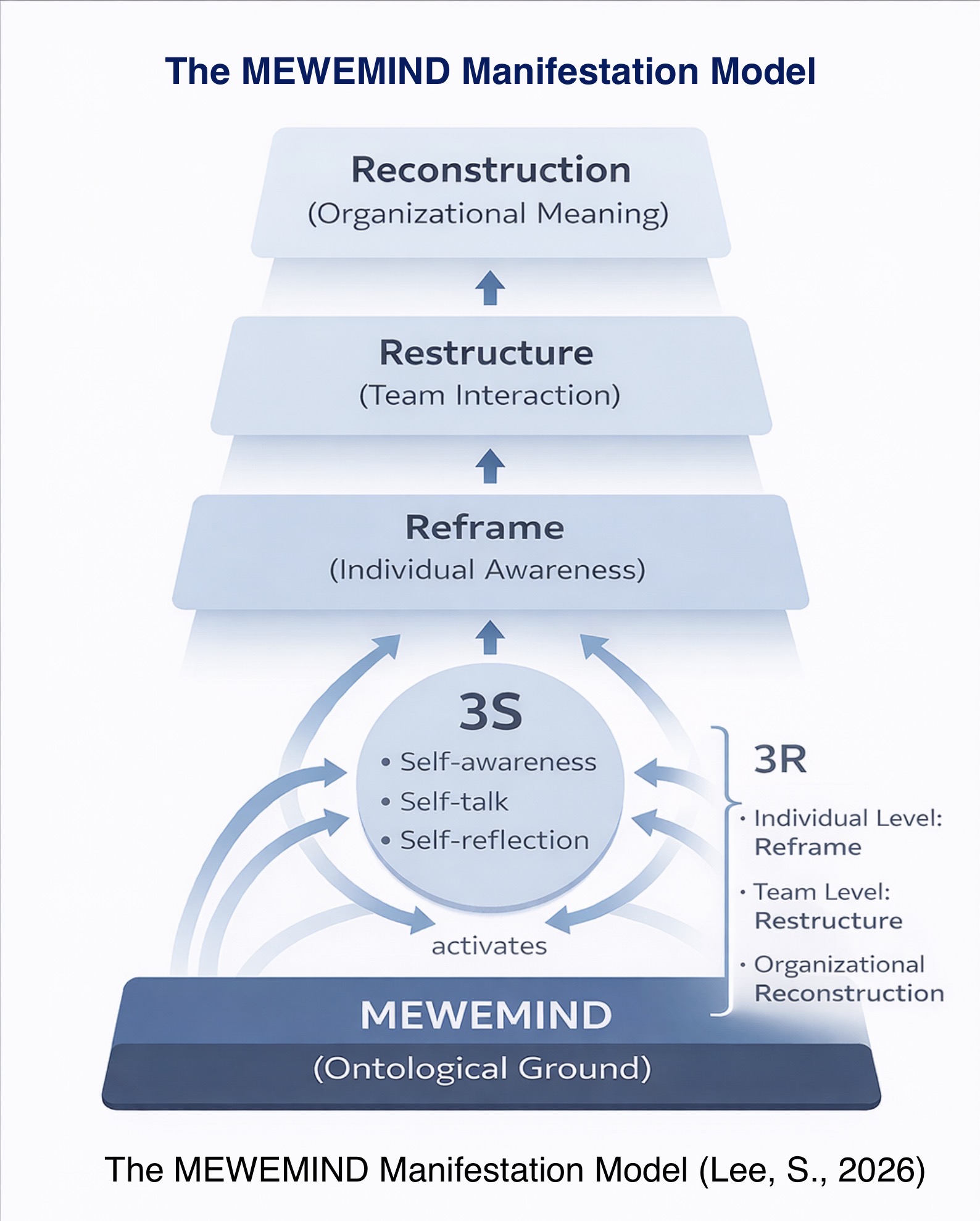
3. WEness at the Limit of Self-Awareness
Self-awareness is commonly conceptualized as enhanced insight into one’s internal states, motivations, and behavioral patterns (Grant, Franklin, & Langford, 2002). However, when self-awareness is pursued beyond narrative identity and psychological traits, a qualitative shift emerges.
At this threshold, individuals begin to recognize that their experiences and decisions are embedded within broader relational systems. Such realizations resonate with systems thinking perspectives, which emphasize interdependence, feedback loops, and co-emergence within human systems (Senge, 1990; Meadows, 2008).
WEness, in this sense, is not a moral stance but a perceptual correction—a more accurate apprehension of systemic reality. MEWEMIND names this transition point where self-awareness becomes relational awareness.
4. Reframing and the Ontological Position of the Observer
Reframing is widely employed in coaching and psychotherapy as a cognitive intervention aimed at altering perspective (Watzlawick, Weakland, & Fisch, 1974). However, without an ontological shift in the perceived position of the observer, reframing risks degenerating into sophisticated self-justification.
MEWEMIND introduces a prior inquiry: whether the self is understood as a detached observer or as an already-embedded participant within relational systems. This distinction parallels sensemaking theory, which emphasizes that meaning is constructed retrospectively within social contexts rather than by isolated individuals (Weick, 1995).
Ontological misalignment at this level explains why reframing often terminates in defensiveness rather than transformation.
5. Implications for Teams and Organizations
From a systems perspective, teams and organizations are not aggregates of individuals but relational configurations that co-produce behavior and meaning (Katz & Kahn, 1978). When team members implicitly operate from an atomistic ontology, collaboration deteriorates regardless of skill or structure.
Similarly, organizational exhaustion and disengagement cannot be fully explained by structural inefficiencies alone. They reflect a deeper assumption that treats human beings as separable resources rather than relational participants (Ghoshal, 2005).
Reconstruction efforts lacking an explicit relational ontology may succeed technically while failing relationally—a pattern frequently observed in large-scale change initiatives.
6. Beyond Moral Interpretation
MEWEMIND is often misread as an ethical appeal toward collectivism. This interpretation obscures its ontological intent. MEWEMIND does not claim that people ought to be relational; it asserts that people already are relational.
Empirical research on collective sensemaking demonstrates that decisions, successes, and failures emerge from interactional processes rather than individual cognition alone (Weick, Sutcliffe, & Obstfeld, 2005). MEWEMIND situates these findings within an explicit ontological frame.
7. Mental Modeling as Ontological Recall
Within this framework, mental modeling must be redefined. Rather than a technique for cognitive adjustment, mental modeling becomes a practice of ontological recall—restoring awareness of relational being.
Only upon this foundation can individual reframing transcend egocentrism, team restructuring move beyond control, and organizational reconstruction avoid alienation. MEWEMIND thus functions as the implicit ground upon which sustainable transformation becomes possible.
Conclusion
Persistent failures in organizational change do not primarily result from individual selfishness or resistance. They stem from an ontological mischaracterization of human beings as isolated entities.
MEWEMIND reverses this mischaracterization by articulating a relational ontology in which WE is already present within ME. This realization represents not the beginning of thought, but its furthest reach.
References
Argyris, C., & Schön, D. A. (1978). Organizational learning: A theory of action perspective. Reading, MA: Addison-Wesley.
Buber, M. (1958). I and Thou (2nd ed.). New York, NY: Scribner.
Emirbayer, M. (1997). Manifesto for a relational sociology. American Journal of Sociology, 103(2), 281–317.
Gergen, K. J. (2009). Relational being: Beyond self and community. Oxford, UK: Oxford University Press.
Ghoshal, S. (2005). Bad management theories are destroying good management practices. Academy of Management Learning & Education, 4(1), 75–91.
Ghoshal, S., & Bartlett, C. A. (1999). The individualized corporation. New York, NY: HarperBusiness.
Grant, A. M., Franklin, J., & Langford, P. (2002). The self-reflection and insight scale. Social Behavior and Personality, 30(8), 821–836.
Heidegger, M. (1962). Being and time (J. Macquarrie & E. Robinson, Trans.). New York, NY: Harper & Row. (Original work published 1927)
Katz, D., & Kahn, R. L. (1978). The social psychology of organizations (2nd ed.). New York, NY: Wiley.
Meadows, D. H. (2008). Thinking in systems: A primer. White River Junction, VT: Chelsea Green.
Senge, P. M. (1990). The fifth discipline: The art and practice of the learning organization. New York, NY: Doubleday.
Watzlawick, P., Weakland, J. H., & Fisch, R. (1974). Change: Principles of problem formation and problem resolution. New York, NY: Norton.
Weick, K. E. (1995). Sensemaking in organizations. Thousand Oaks, CA: Sage.
Weick, K. E., Sutcliffe, K. M., & Obstfeld, D. (2005). Organizing and the process of sensemaking. Organization Science, 16(4), 409–421.
'4. 코칭심리연구 > 코칭심리 탐구' 카테고리의 다른 글
| 코칭의 본질 (0) | 2026.02.08 |
|---|---|
| MEWEMIND란 무엇인가 (0) | 2026.02.05 |
| MEWEMIND의 자리 (0) | 2026.02.04 |
| 멘탈 모델링 코칭이 갖는 의미 (0) | 2026.01.30 |
| 멘털 모델링 코칭과 슬로건 (0) | 2026.01.23 |


