
| 일 | 월 | 화 | 수 | 목 | 금 | 토 |
|---|---|---|---|---|---|---|
| 1 | 2 | 3 | ||||
| 4 | 5 | 6 | 7 | 8 | 9 | 10 |
| 11 | 12 | 13 | 14 | 15 | 16 | 17 |
| 18 | 19 | 20 | 21 | 22 | 23 | 24 |
| 25 | 26 | 27 | 28 | 29 | 30 | 31 |
- 관점 코칭
- Coach Sukjae Lee
- 생각 파트너 이석재
- Effectiveness Coaching Methodology
- 효과성코칭워크숍
- 효과성 코칭
- 현장중심 코칭심리학
- 효과성 코칭 방법론
- 현징증심 코칭심리학
- Effectiveness Coaching
- 코칭방법론
- 떠도는 마음 사용법
- 3S-FORM Coaching Model
- 코칭심리학
- 증거기반코칭
- 효과성 코칭 모델
- 씽킹 파트너
- 효과성 프레임워크
- 결정적 행동
- 코칭 프레임워크
- thinking partner
- 코칭심리학 공부방
- 코치올
- 경영심리학자의 효과성 코칭
- 이종서 코치
- 실행력을 높이는 코칭심리학 수업
- 원하는 결과
- 관점 전환
- 3S-FORM Coaching Model과 뇌과학의 결합
- Effectiveness Coaching Model
- Today
- Total
코치올
Effectiveness Coaching: Individual Coaching vs Team Coaching 본문
Effectiveness Coaching: Individual Coaching vs Team Coaching
생각파트너 이석재 2025. 12. 7. 21:38Sukjae Lee Ph.D.
Creator of the Effectiveness Coaching Methodology
2025. 12. 7.
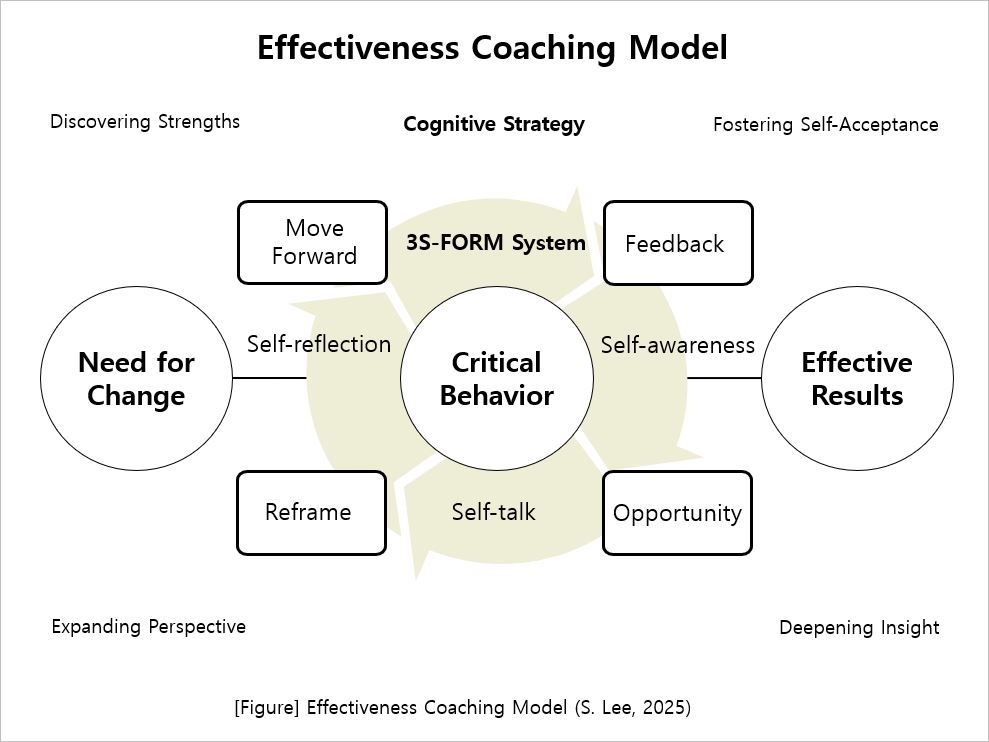
How this model can be applied in a team setting versus individual coaching? Any prticular or specific consideration to take when people attempt to apply?
Here's a breakdown of the application and the key considerations for each setting:
👥 Applying the Model to a Team Setting
When coaching a team, the focus of the model shifts from individual, internal change to collective, observable change in team dynamics and performance.
1. The Shift in Focus
| Model Component | Individual Coaching (Focus) | Team Coaching (Focus) |
| 3S (Inner Engine) | Individual's Self-Talk and personal Self-Awareness. | Shared Understanding of team dynamics and collective Self-Reflection on group processes. |
| B (Critical Behavior) | A specific action of the coachee (e.g., yelling at staff). | An observable Team Interaction (e.g., failing to hold peers accountable or siloed communication). |
| C (Consequence) | Personal outcome (e.g., reduced stress, achieved goal). | Collective outcome (e.g., missed deadline, high quality output, improved cross-functional trust). |
| FORM | Coach facilitates one-on-one dialogues. | Coach facilitates Group Dialogue and consensus-building processes. |
2. Application Steps in a Team Setting
- F (Feedback): The coach uses diagnostic tools (e.g., team effectiveness surveys, meeting observations, 360° feedback) to present data on the team's collective Critical Behavior (B) and its impact on the desired Consequence (C). For example: "The data shows that 70% of team members feel decisions made in meetings are later reversed."
- O (Opportunity): The coach helps the team articulate a shared vision of their collective success. Instead of asking, "What can you achieve?", the question is, "What would be possible if we were functioning at our best?" (e.g., "We would be the most innovative team in the company.")
- R (Reframe): The coach challenges the team's collective limiting beliefs (Group Self-Talk). This could be challenging norms like: "We can't confront conflict" or "Our work is too complicated to share." The reframe creates a New Team Norm (e.g., "Conflict is an opportunity to strengthen solutions, not a personal attack.").
- M (Move Forward): The team collaboratively designs new, measurable Team Operating Agreements and Accountability Mechanisms. This includes defining the new collective behavior (e.g., "We will assign an owner and a deadline to every decision before leaving a meeting.").
🛑 Specific Considerations for Application
Whether coaching an individual or a team, there are crucial considerations to ensure the model's success.
1. For Individual Coaching
- Diagnostic Depth: Ensure the ABC Analysis is based on sufficient, objective data (not just the individual's perception). Self-Awareness (3S) requires confronting reality.
- Willingness: The coachee must genuinely be willing to change their Self-Talk. If they are resistant, the Reframe (R) step will be ineffective.
- Confidentiality: The coach must maintain strict confidentiality to foster the trust required for the coachee to expose their vulnerable 3S internal thoughts.
2. For Team Coaching (The Greatest Challenges)
- The "Whole" is Greater: You are not coaching a collection of individuals; you are coaching the system of their interactions. All steps must address the collective dynamic.
- Psychological Safety: This is the most critical factor. The team must feel safe to discuss the dysfunctional Critical Behavior (B) without fear of individual reprisal. If safety is low, the Feedback (F) step will be denied, and the Reframe (R) will be superficial.
- The Leader's Role: The team leader must fully participate and visibly model the desired change. If the leader doesn't commit to the new Team Norms (M), the rest of the team will revert to old behaviors.
- Consensus vs. Compliance: The team must genuinely buy into the New Norms (M), achieving consensus. If it's just compliance, the behavioral change will disappear as soon as the coach leaves.
And explore an example of a collective limiting belief that is successfully reframed in a team setting.
It's a powerful way to see the Reframe (R) step in action at a team level.
Here is an example of a common Collective Limiting Belief that often surfaces in teams and how the coach facilitates the Reframe using the 3S-FORM model:
🛑 Scenario: The "Siloed Team"
F (Feedback) and B (Critical Behavior)
- Antecedent (A): A deadline requires input from two different functions (e.g., Marketing and Product Development).
- Critical Behavior (B): Individuals from each function work in isolation, delay sharing incomplete work, and blame the other function when the final deliverable is poor.
- Actual Consequence (): Missed deadlines, low-quality results, and high interpersonal friction.
The Collective Limiting Belief (Old Self-Talk)
Through facilitated dialogue (using the 3S: Self-Awareness and observation), the coach uncovers the hidden, shared assumption that drives the siloed behavior:
Old Self-Talk: "Our job is to protect our function's interests. Sharing work early is dangerous because the other team will use incomplete data to criticize us. It's easier and safer to work alone until it's perfect."
This belief acts as a defense mechanism, preventing collaboration.
✨ R (Reframe): Challenging the Belief
The coach uses the Opportunity (O) established earlier (e.g., "The opportunity is to be the fastest, most innovative product team in the organization") to challenge this limiting belief directly.
| Aspect | Limiting Belief (Old Team Self-Talk) | Reframe (New Team Norm/Belief) |
| Safety/Risk | "Sharing incomplete work exposes us to risk/criticism." | "Sharing early reduces our risk. It guarantees that errors are found cheaply and early, protecting the final outcome." |
| Relationship | "The other team is the 'enemy' or the 'critic.'" | "The other team is our quality control and partner. We rely on their expertise to make our work stronger." |
| Goal | "The goal is to deliver our perfect component." | "The goal is the shared, successful final product. We fail or succeed as one system." |
The New Collective Behavior Commitment (Leading to M - Move Forward)
The successful Reframe allows the team to adopt a new, agreed-upon rule of engagement (a new Team Norm):
New Team Norm (Action): "We will establish a '50% Check-in' rule. Regardless of whether our work is 'perfect,' we will hold a mandatory, no-judgment check-in with the partner team when our work hits 50% completion to align expectations."
This new rule is the behavioral commitment that is then detailed and made accountable in the Move Forward (M) step. The team has now successfully used the 3S (Self-Awareness, Self-Talk, Self-Reflection) engine to change their underlying belief about collaboration, ensuring the new behavior is internally driven.
Does this example clearly show how the Reframe shifts from an individual mindset to a shared team norm?
References
Lee, Sukjae (2006). Develop 18 Core Leadership Competencies. Seoul: Kim & Kim Books.
Lee, Sukjae (2014). Effectiveness Coaching by a Business Psychologist. Seoul: Kim & Kim Books.
Lee, Sukjae (2019). Thought Revolution That Changes My Life. Seoul: Wildbooks.
Lee, Sukjae (2020). Coaching Methodology. Seoul: Korea Coaching Supervision.
Lee, Sukjae (2020). How to Use a Wandering Mind. Seoul: Plan B Design.
Lee, Sukjae (2023). Field-Focused Coaching Psychology. Seoul: Hakjisa.
Lee, Sukjae (2024). Coaching Psychology Class for Boosting Execution. Seoul: Hakjisa.
Lee, Sukjae (2024). Thinking Partner. Gyeonggi: Moa Books.
Lee, Sukjae & Lee, Jongseo (2025). Perspective Shifting. Seoul: Parkyoungstory.
'3. 코칭심리연구 > 코칭심리 탐구' 카테고리의 다른 글
| Reframe is Critical for Updating Mental Models (0) | 2025.12.08 |
|---|---|
| How ELA develops your Self-awareness? (0) | 2025.12.08 |
| Effectiveness Coaching: Updates and Trends (0) | 2025.12.07 |
| Perspective Shifting and Psychology within Effectiveness Coaching (0) | 2025.12.07 |
| The 6-Step Process for Completing Perspective Transformation (1) | 2025.12.07 |


