

| 일 | 월 | 화 | 수 | 목 | 금 | 토 |
|---|---|---|---|---|---|---|
| 1 | 2 | 3 | 4 | 5 | 6 | 7 |
| 8 | 9 | 10 | 11 | 12 | 13 | 14 |
| 15 | 16 | 17 | 18 | 19 | 20 | 21 |
| 22 | 23 | 24 | 25 | 26 | 27 | 28 |
- 코치올
- Effectiveness Coaching Model
- thinking partner
- 씽킹 파트너
- 증거기반코칭
- 효과성 코칭
- 코칭 프레임워크
- Coach Sukjae Lee
- 생각 파트너 이석재
- 효과성 코칭 방법론
- 코칭방법론
- 효과성 코칭 모델
- 실행력을 높이는 코칭심리학 수업
- 효과성 프레임워크
- Effectiveness Coaching Methodology
- Sukjae Lee Ph.D.
- 3S-FORM Coaching Model
- 관점 코칭
- 효과성코칭워크숍
- 이종서 코치
- 경영심리학자의 효과성 코칭
- 원하는 결과
- 현징증심 코칭심리학
- 관점 전환
- Effectiveness Coaching
- 결정적 행동
- 현장중심 코칭심리학
- 떠도는 마음 사용법
- 코칭심리학 공부방
- 3S-FORM Coaching Model과 뇌과학의 결합
- Today
- Total
코치올
The 6-Step Process for Completing Perspective Transformation 본문
The 6-Step Process for Completing Perspective Transformation
생각파트너 이석재 2025. 12. 7. 09:55Sukjae Lee Ph.D.
Creator of the Effectiveness Coaching Methodology
2025. 12. 7.
The 6-Step Process for Completing Perspective Transformation
Perspective transformation can be done either self-directed or with the help of an expert. As a professional coach and social psychologist, I have studied the psychological mechanisms that change people's thoughts and behaviors. I reinterpreted concepts like perspective-taking (Epley et al., 2004) and perspective transformation (Mezirow, 1978) within the framework of Effectiveness Coaching (Lee, Sukjae, 2014; 2020a) and developed the 6-step perspective transformation process. In this process, I realized that clearly identifying and understanding one's existing perspective is the starting point for perspective change. Therefore, to complete perspective transformation, one must first explore the perspective. Based on this learning and the perspective transformation process, I have helped corporate leaders, couples, students, and career-interruption individuals with perspective transformation for the past 23 years. This involves changing people's existing perspectives into new ones that increase the probability of achieving desired results. This work has been named 'Perspective Coaching' (Lee, Sukjae, 2014; 2023).
The psychological mechanisms underlying perspective transformation exist on a shallow level, which has a short-term impact, and a deep level, which has a long-term and sustained impact. The latter requires a structured process. This framework focuses on the deep level. The representative attributes of the concepts constituting the 6 steps are Perspective Exploration, which prepares for cognitive change, and Perspective Realization of the explored perspective in life. These two categories are implemented through three specific actions each, and each action unfolds step-by-step, forming the structure of the six chapters in this book.

I. The 6-Step Process for Perspective Transformation
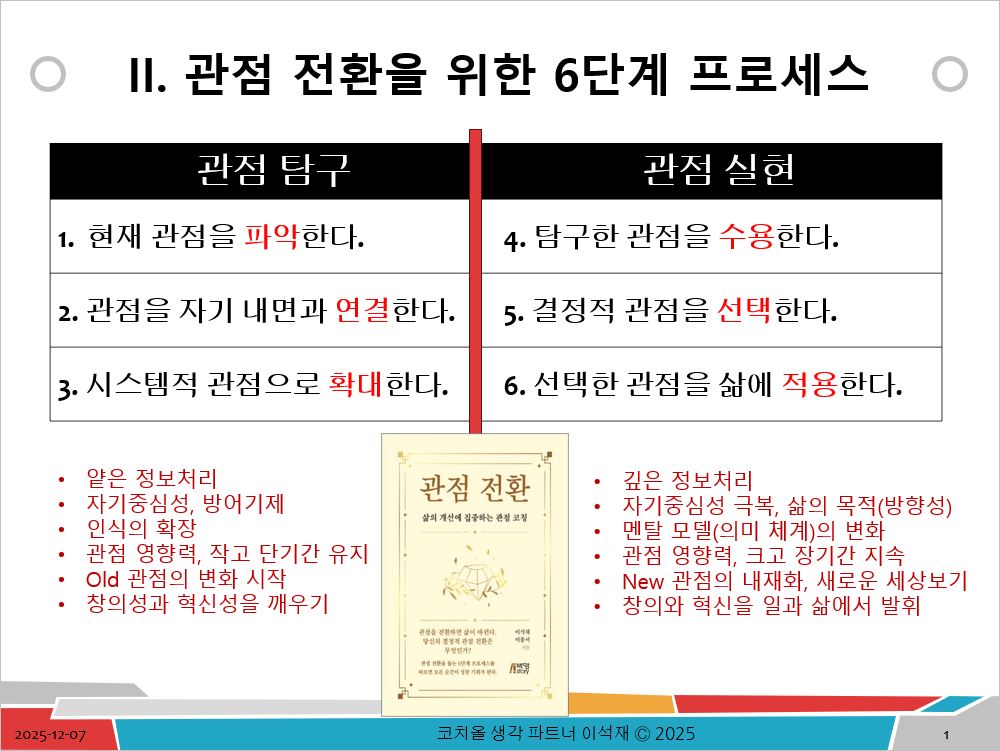
The perspective transformation process consists of the following six steps:
🔎 Perspective Exploration
- Step 1: Identify the current perspective
- Step 2: Connect the perspective with one's inner self.
- Step 3: Expand to a systemic perspective.
✨ Perspective Realization
- Step 4: Accept the explored perspective.
- Step 5: Choose the decisive perspective.
- Step 6: Apply the chosen perspective to life.
II. Psychological Characteristics
| Stage | Key Psychological Features |
| Perspective Exploration |
* Shallow information processing
* Egocentricity, defense mechanisms
* Expansion of awareness
* Perspective influence: Small and short-term
* Beginning of change in the Old Perspective
* Awakening creativity and innovation
|
| Perspective Realization |
* Deep information processing
* Overcoming egocentricity, life purpose (direction)
* Change in mental model (meaning system)
* Perspective influence: Large and long-term
* Internalization of the New Perspective, seeing a new world
* Exerting creativity and innovation in work and life
|
III. Overcoming Resistance and Finding Your Decisive Perspective
When one attempts to change a perspective, the inner self instinctively resists. At this time, people may fabricate emotions or state something untrue as fact. Consider a scenario where an important meeting partner suddenly picks up their phone and doesn't focus on the conversation. This might be seen as impolite behavior and an act of disrespect toward you. However, that person might be texting an ailing family member, having been unable to focus on the conversation even before meeting you. If you keep your existing perspective open to all possibilities, the true meaning of the other person's action comes into view.
By exploring your perspective in your own life situation, you can avoid being swayed by negative thoughts that automatically arise in uncomfortable situations. Instead, you can grasp and respond to the situation with a balanced view. You can also let go of stereotypes or prejudices learned throughout life and accept the situation as an opportunity to cultivate a growth-oriented mindset. This provides a chance to reinvent yourself as a more positive person than before.
“What is your Decisive Perspective right now?”
This question is simple yet possesses piercing power. The decisive perspective increases the probability of achieving desired results. I encourage you to read this book and find your own decisive perspective.
IV. Summary of the Two Main Stages in Perspective Transformation
The 6-Step Process for Perspective Transformation is divided into two core stages: Perspective Exploration and Perspective Realization. These stages represent a transition from preparing for cognitive change to implementing that change in one's life.
1. Perspective Exploration (Steps 1–3)
This is the preparatory stage focused on understanding the current perspective and broadening one's awareness.
| Feature | Description |
| Goal | Identify and understand the existing perspective and prepare for cognitive change. |
| Steps | 1. Identify the current perspective. 2. Connect the perspective with one's inner self. 3. Expand to a systemic perspective.
|
| Psychology | Characterized by shallow information processing , egocentricity, and defense mechanisms. This stage involves an expansion of awareness and is the beginning of the Old Perspective's change. |
| Impact | The initial influence of the perspective is small and short-term. |
2. Perspective Realization (Steps 4–6)
This is the implementation stage where the explored perspective is accepted, refined, and applied for long-term, sustained change in one's life.
| Feature | Description |
| Goal | Internalize the new, desired perspective and apply it to achieve better results in work and life. |
| Steps | 4. Accept the explored perspective. 5. Choose the decisive perspective. 6. Apply the chosen perspective to life. |
| Psychology | Characterized by deep information processing , overcoming egocentricity, and defining one's life purpose (direction). This stage results in a change in the mental model (meaning system). |
| Impact | The influence of the new perspective is large and long-term. This is where the New Perspective is internalized and creativity and innovation are exerted. |
V. The Six Steps of Perspective Transformation
The 6-Step Process for Perspective Transformation is divided into two main stages, Exploration and Realization, each containing three steps that guide the change from an old viewpoint to a new, effective one.
1. Stage 1: Perspective Exploration (Preparing for Change)
This initial stage is where you identify your current perspective, confront your inner resistance, and begin to broaden your view beyond yourself.
- Step 1: Identify the current perspective. This involves clearly defining and understanding the viewpoint you currently hold on a specific situation or issue.
- Step 2: Connect the perspective with one's inner self(mental model). This step requires confronting internal biases, such as egocentricity and defense mechanisms, which instinctively resist change.
- Step 3: Expand to a systemic perspective. You move beyond a self-centered view to see the situation in a broader context, considering all related factors and systems. This initiates the expansion of awareness.
2. Stage 2: Perspective Realization (Applying the Change)
This final stage is focused on accepting the insights gained during exploration, selecting a new perspective, and fully applying it to your life for long-term change.
- Step 4: Accept the explored perspective. You choose to embrace the new potential viewpoints discovered during the exploration phase, moving past your initial resistance.
- Step 5: Choose the decisive perspective. This is the critical selection of the most effective, growth-oriented perspective—the "Decisive Perspective"—that increases the probability of achieving desired results.
- Step 6: Apply the chosen perspective to life. You internalize the new perspective and put it into practice, leading to long-term and lasting influence and allowing you to exert creativity and innovation in your work and life.
An example of how a situation might change when viewed through the lens of this 6-step process. And another example illustrating how the 6-Step Perspective Transformation Process might apply to a common workplace scenario.
VI. Example: The Uncommunicative Coworker
Scenario
An employee, Sarah, is working on a high-stakes project with a coworker, Tom. Tom frequently fails to respond to Sarah's emails promptly, often delays providing necessary data, and seems generally aloof during team meetings. Sarah feels frustrated and disrespected.
1. Stage 1: Perspective Exploration
| Step | Sarah's Action | Result of Exploration |
| Step 1: Identify the current perspective. | Sarah defines her current perspective: "Tom is incompetent and intentionally disrespecting my work. He doesn't prioritize this project." | This perspective is rooted in egocentricity and triggers negative emotions. |
| Step 2: Connect the perspective with one's inner self. | Sarah recognizes that her frustration is tied to her deep-seated need for control and recognition. Her current perspective is a defense mechanism protecting her from feeling undervalued. | Sarah identifies her inner resistance and emotional attachment to being "right" about Tom. |
| Step 3: Expand to a systemic perspective. | Sarah investigates Tom's workload and role. She discovers Tom is managing three major concurrent projects and recently took on a challenging family responsibility. | Sarah's awareness expands. She shifts from viewing Tom's behavior as a personal slight to viewing it as a symptom of potential systemic overload. |
2. Stage 2: Perspective Realization
| Step | Sarah's Action | Result of Realization |
| Step 4: Accept the explored perspective. | Sarah acknowledges the possibility that Tom's actions are driven by stress and workload, not malice. She accepts this broader, non-personal view of the situation. | The emotional charge is released. Sarah moves toward deep information processing rather than reactive emotion. |
| Step 5: Choose the decisive perspective. | Sarah chooses the new perspective: "Tom is overwhelmed, not resistant. I need to help him prioritize the right information, not just flood him with requests." (This is the Decisive Perspective). | This new perspective increases the probability of achieving desired results (completing the project successfully). |
| Step 6: Apply the chosen perspective to life. | Sarah schedules a brief meeting with Tom, asking, "What is the single most critical piece of data you need from me this week?" and proposes using a shared priority tracker instead of emails. | This leads to the internalization of the new perspective and a positive change in the working relationship, demonstrating creativity and innovation in problem-solving. |
Outcome: By completing the process, Sarah moves from anger and stagnation to collaboration and effectiveness, embodying a growth-oriented mindset.
Let's explore a personal relationship example to see the 6-Step Perspective Transformation Process in action.
VII. Example: The Distant Partner
Scenario
Mark and Lisa have been together for five years. Lately, Lisa feels Mark has been emotionally distant. He comes home and immediately retreats to his computer or phone, and their conversations are brief. Lisa feels lonely and concludes he doesn't value their relationship anymore.
1. Stage 1: Perspective Exploration
| Step | Lisa's Action | Result of Exploration |
| Step 1: Identify the current perspective. | Lisa defines her current perspective: "Mark doesn't love me anymore. He is intentionally shutting me out and prioritizing his hobbies over me." | This perspective is highly egocentric and causes immediate pain and anger. |
| Step 2: Connect the perspective with one's inner self. | Lisa recognizes that this feeling triggers her fear of abandonment from her past. Her current perspective is a defense mechanism protecting her from the pain of rejection. | Lisa understands the source of her resistance and her intense emotional reaction is tied to old wounds. |
| Step 3: Expand to a systemic perspective. | Lisa asks Mark about his day without accusation. She learns his company recently laid off several employees, and he’s been working extra hours trying to cover their workload, causing him severe stress and burnout. | Lisa's awareness expands. She shifts from viewing his behavior as "shutting her out" to seeing it as a symptom of systemic stress and exhaustion. |
2. Stage 2: Perspective Realization
| Step | Lisa's Action | Result of Realization |
| Step 4: Accept the explored perspective. | Lisa acknowledges that Mark’s distance is about his own struggle, not a rejection of her. She accepts this explanation, removing the personal hurt. | The emotional reactivity subsides. Lisa begins to engage in deep information processing about his situation. |
| Step 5: Choose the decisive perspective. | Lisa chooses the new perspective: "Mark is struggling with stress and needs support, not judgment. How can I create a safe space for him to decompress and reconnect?" (This is the Decisive Perspective). | This new perspective increases the probability of achieving desired results (rebuilding intimacy and trust). |
| Step 6: Apply the chosen perspective to life. | Lisa decides to stop demanding immediate attention. Instead, she greets him with a hug and suggests a no-phone "decompression window" for 30 minutes each night where they simply exist quietly together. | This leads to the internalization of the new perspective and allows her to exert compassion and innovation in strengthening their relationship. |
Outcome: Lisa moves from feeling rejected and isolating herself to feeling empowered and proactively supporting her partner, ultimately helping the relationship heal.
The Perspective Transformation process involves several key psychological concepts that define how we process information, relate to others, and ultimately change our meaning systems.
Here is a look at the core psychological terms involved in the two stages:
VIII. Core Psychological Terms
1. Terms in Perspective Exploration
The initial stage deals with the natural human tendency toward self-focus and immediate emotional reaction.
- Egocentricity (or Egocentrism): This is the psychological state of being focused solely on one's own perspective, experiences, and needs, often to the exclusion of understanding or considering those of others. In this context, it prevents you from seeing that a coworker's or partner's actions might be about them and not a slight against you.
- Defense Mechanism: An unconscious psychological strategy used to protect a person from anxiety, unacceptable thoughts, or conflicts. For example, assuming someone is rejecting you (as in the Distant Partner example) can be a defense mechanism to preemptively manage the pain of perceived rejection.
- Shallow Information Processing: This refers to the cognitive approach where we focus only on the surface features, emotional tone, or immediate personal impact of information, rather than deeply analyzing the context, complexity, or system involved. It is characterized by short-term influence.
- Expansion of Awareness: The process of broadening one's perception beyond the immediate self-centered view. In the 6-step process, this happens when you shift to a systemic perspective (Step 3).
2. Terms in Perspective Realization
The second stage involves moving past initial resistance to achieve profound and lasting change in one's core beliefs.
- Deep Information Processing: This is the cognitive approach where information is actively analyzed, related to existing knowledge, and integrated into a meaningful system. It is necessary for achieving long-term and sustained influence.
- Overcoming Egocentricity: The successful shift from self-focus (Step 2) to genuine consideration of others' perspectives and systemic factors (Step 3), allowing the individual to define a life purpose (direction) that extends beyond personal needs.
- Mental Model (Meaning System) Change: A mental model is a deeply held set of assumptions, images, and generalizations that influence how we understand the world and take action. Perspective Transformation fundamentally seeks a change in this mental model to internalize a New Perspective.
- Internalization of the New Perspective: The final step where the chosen Decisive Perspective (Step 5) is fully adopted and applied to daily life and work (Step 6), resulting in a lasting change in thought and behavior and allowing for the realization of creativity and innovation.
IX. Psychology and Effectiveness Coaching
The 6-step process was developed by reinterpreting established psychological concepts—like perspective-taking and perspective transformation—within the framework of Effectiveness Coaching (Lee, Sukjae, 2014; 2020a).
Effectiveness Coaching is an approach focused on changing people's thoughts and behaviors to increase the probability of achieving desired results. The psychological terms involved in the 6-step process describe the mechanisms of this transformation:
1. From Resistance to Acceptance (Exploration Stage)
The first three steps of the model are designed to overcome the natural human tendency toward internal resistance and subjective perception, which are counterproductive to effectiveness.
- Egocentricity and Defense Mechanisms: In terms of Effectiveness Coaching, these are seen as the primary obstacles to self-improvement and effective problem-solving. The process forces the individual to recognize and bypass these internal roadblocks (Step 2) before they can find an effective solution.
- Shallow vs. Deep Information Processing: A shallow approach leads to temporary, short-term influence, which is not effective or sustainable. Effectiveness Coaching specifically requires a structured process that moves the individual toward deep information processing to ensure the new perspective has a long-term, sustained impact.
- Expansion of Awareness: This systemic shift (Step 3) is critical because effectiveness in life or work is rarely based on a single, isolated factor. By broadening awareness, the individual gains a balanced view to grasp and respond to the situation, rather than being swayed by automatic negative thoughts.
2. From Internal Insight to External Action (Realization Stage)
The realization stage focuses on turning the cognitive shift into concrete, observable actions that drive success.
- Mental Model Change: The goal of this coaching is not just temporary behavior modification but a change in the deep-level meaning system. This is essential for long-term effectiveness, as a changed mental model ensures the new behavior is internalized.
- Overcoming Egocentricity and Life Purpose (Direction): Overcoming egocentricity in this stage allows the individual to define a direction that is more constructive and effective for their relationships and goals. This shift aligns with the coaching goal of seeking results rather than simply validating one's feelings.
- Decisive Perspective: This is the core outcome of the process (Step 5). In the coaching context, the Decisive Perspective is the single viewpoint chosen because it is the one most likely to increase the possibility of achieving desired results.
- Creativity and Innovation: The final payoff of the process (Step 6) is the ability to exert creativity and innovation in work and life. By adopting an effective, new perspective, the individual unlocks new ways of thinking and problem-solving.
In essence, the 6-step process(Lee, S., & Lee, J., 2025) uses psychological knowledge to structure a path that transforms temporary mental shifts into a profound and effective change in one's mental model and life direction.
Epley, N., Keysar, B., Van Boven, L., & Gilovich, T. (2004). Perspective taking as egocentric anchoring and adjustment. Journal of Personality and Social Psychology, 87, 327-339.
Lee, Sukjae & Lee, Jongseo (2025). Perspective Shifting. Seoul: Parkyoungstory.
Mezirow, J. (1978) Perspective Transformation. Adult Education Quarterly, 28, 100-110.
References
Lee, Sukjae (2006). Develop 18 Core Leadership Competencies. Seoul: Kim & Kim Books.
Lee, Sukjae (2014). Effectiveness Coaching by a Business Psychologist. Seoul: Kim & Kim Books.
Lee, Sukjae (2019). Thought Revolution That Changes My Life. Seoul: Wildbooks.
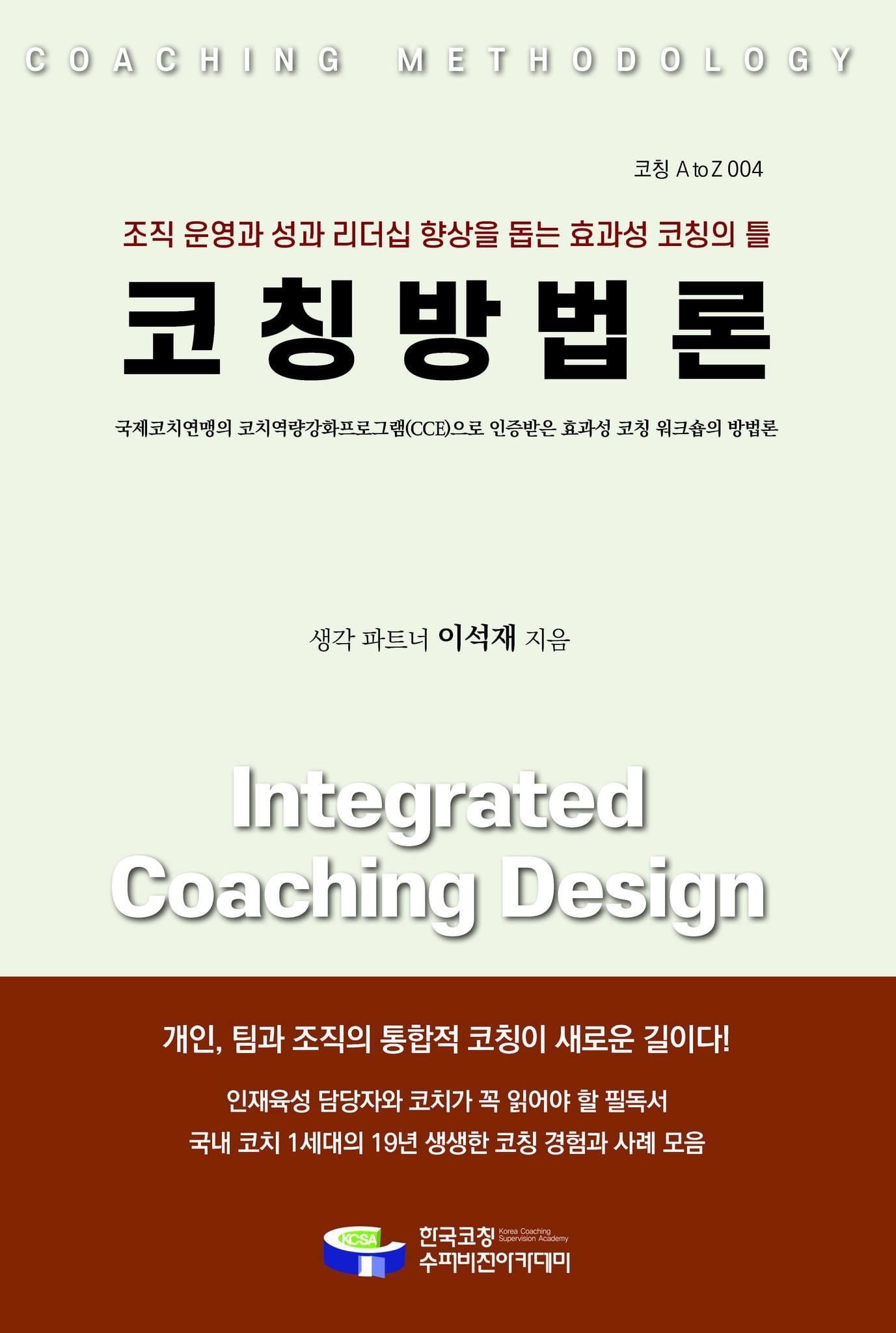
Lee, Sukjae (2020). Coaching Methodology. Seoul: Korea Coaching Supervision.
Lee, Sukjae (2020). How to Use a Wandering Mind. Seoul: Plan B Design.
Lee, Sukjae (2023). Field-Focused Coaching Psychology. Seoul: Hakjisa.
Lee, Sukjae (2024). Coaching Psychology Class for Boosting Execution. Seoul: Hakjisa.
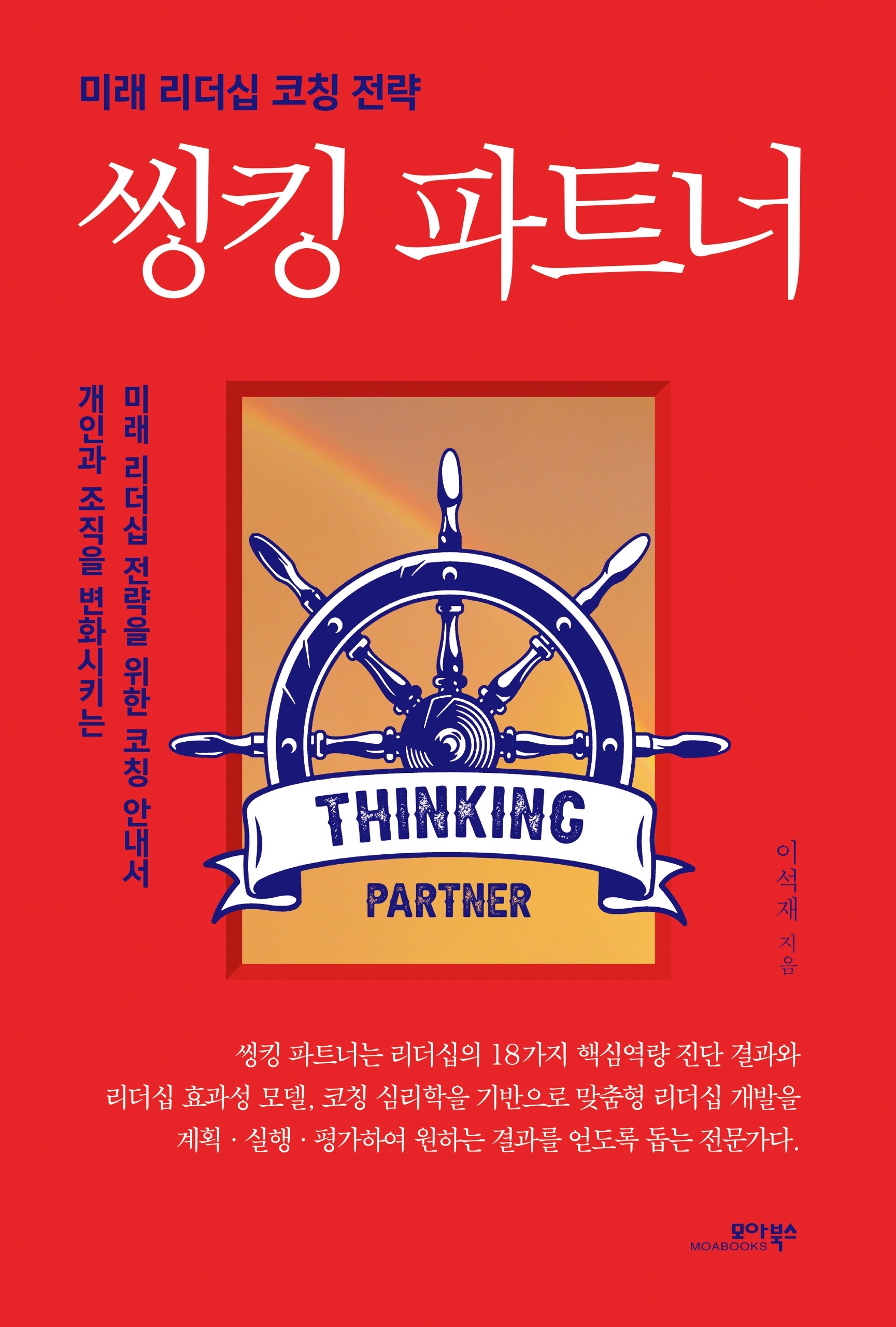
Lee, Sukjae (2024). Thinking Partner. Gyeonggi: Moa Books.
Lee, Sukjae & Lee, Jongseo (2025). Perspective Shifting. Seoul: Parkyoungstory.
관점 전환을 완성하는 6단계 프로세스
관점 전환은 자기주도적으로 할 수 있고 전문가의 도움을 받을 수도 있습니다. 저는 전문 코치이며 사회심리학자로서 사람의 생각과 행동을 바꾸는 심리기제를 연구하면서 대인관계 심리에서 관점 취하기(Epley et al, 2004)와 관점 전환(Mezirow, 1978) 등을 효과성 코칭(이석재, 2014; 2020a)의 시각에서 재해석하고 6단계 관점 전환 프로세스를 개발했습니다. 이 과정에서 기존의 관점을 명확하게 파악하고 이해하는 것이 관점 변화의 시작이라는 점을 간파했습니다. 따라서 관점 전환을 완성하기 위해서는 먼저 관점을 탐구해야 합니다. 이러한 학습과 관점 전환 프로세스를 토대로 지난 23년 동안 기업의 리더, 부부, 학생, 경력단절자 등을 대상으로 관점 전환을 도왔습니다. 사람들이 가지고 있는 기존 관점을 원하는 결과를 얻을 수 있는 가능성을 높이는 새로운 관점으로 바꾸는 것입니다. 이러한 작업을 ‘관점 코칭’이라고 이름 붙였습니다(이석재, 2014; 2023).
관점 전환이 일어나는 심리 기제는 영향력이 단기적인 얕은 수준과 장기적이며 지속적인 영향력을 갖는 깊은 수준이 있습니다. 후자는 구조화된 프로세스를 필요로 합니다. 그러나 일부 프로세스를 실행해도 일시적인 관점 전환이 일어납니다. 이 책은 후자에 초점을 맞춥니다. 관점 전환을 위한 6단계를 구성하는 개념들의 대표적 속성은 인식변화를 준비하는 관점 탐구와 탐구한 관점을 삶에서 실현하는 것입니다. 이들 두 범주는 각각 3가지 구체적인 실행으로 구현되며 각 실행은 단계적으로 전개됩니다. 각 실행을 이 책의 제1장부터 제6장의 제목으로 사용했습니다.
관점 전환의 6단계 프로세스(이석재, 2014; 2023)
관점을 바꾸고자 할 때 내면은 본능적으로 저항합니다. 이때 사람들은 감정을 꾸며내거나 사실이 아닌 것을 진실이라고 말할 수 있습니다. 중요한 미팅에서 상대방이 갑자기 핸드폰을 들고 대화에 집중하지 않는 경우가 있습니다. 그 모습이 결례이며 당신을 무시하는 행위라고 볼 수 있습니다. 그러나 그 사람은 아픈 가족에게 문자를 보내고 있을 수도 있습니다. 당신을 만나기 전부터 대화에 집중하지 못하는 어려움에 처해 있습니다. 이때 당신이 기존의 관점을 모든 가능성에 열어 두면 상대방의 행동이 갖는 의미가 눈에 들어옵니다.
각자 처한 삶에서 관점을 탐구하면 불편한 상황에서 자동적으로 떠오르는 부정적인 생각에 휘둘리지 않고, 균형 잡힌 시각으로 상황을 파악하고 대처할 수 있습니다. 또 삶을 통해 학습한 고정관념이나 편견을 내려놓고 성장지향의 사고방식을 키워보는 기회로 받아들일 수도 있습니다. 이전보다 더 긍정적인 사람으로 자신을 재창조할 수 있는 기회를 갖는 것입니다.
“지금 당신의 결정적 관점은 무엇인가?”
이 질문은 간단하지만 촌철살인의 힘을 갖고 있습니다. 결정적 관점은 원하는 결과를 얻을 가능성을 높입니다. 당신도 이 책을 읽고 본인만의 결정적 관점을 찾아보시기 바랍니다.
Source: Lee, Sukjae & Lee, Jongseo (2025). Perspective Shifting. Seoul: Parkyoungstory.
참고문헌
이석재 (2006). 18가지 리더십 핵심역량을 개발하라. 서울: 김앤김북스.
이석재 (2014). 경영심리학자의 효과성 코칭. 서울: 김앤김북스.
이석재 (2019). 내 삶을 바꾸는 생각 혁명. 서울: 와일드북.
이석재 (2020). 코칭방법론. 서울: 한국코칭수퍼비전.
이석재 (2020). 떠도는 마음 사용법. 서울: 플랜비디자인.
이석재 (2023). 현장중심 코칭심리학. 서울: 학지사.
이석재 (2024). 실행력을 높이는 코칭심리학 수업. 서울: 학지사.
이석재 (2024). 씽킹 파트너. 경기: 모아북스.
이석재.이종서 (2025). 관점 전환. 서울: 박영스토리.
 |
 |
 |
 |
 |
 |
'3. 코칭심리연구 > 코칭심리 탐구' 카테고리의 다른 글
| Effectiveness Coaching: Updates and Trends (0) | 2025.12.07 |
|---|---|
| Perspective Shifting and Psychology within Effectiveness Coaching (0) | 2025.12.07 |
| 북토크를 마치고 (0) | 2025.12.07 |
| 오늘은 아주 특별한 날 (0) | 2025.12.06 |
| What is the Effectiveness Coaching Model? (0) | 2025.11.30 |


