
| 일 | 월 | 화 | 수 | 목 | 금 | 토 |
|---|---|---|---|---|---|---|
| 1 | 2 | 3 | 4 | 5 | 6 | 7 |
| 8 | 9 | 10 | 11 | 12 | 13 | 14 |
| 15 | 16 | 17 | 18 | 19 | 20 | 21 |
| 22 | 23 | 24 | 25 | 26 | 27 | 28 |
| 29 | 30 | 31 |
- Coach Sukjae Lee
- 실행력을 높이는 코칭심리학 수업
- 3S-FORM Coaching Model과 뇌과학의 결합
- 효과성 코칭
- 효과성 코칭 방법론
- 미위마인드 mewemind.com
- 이종서 코치
- 현징증심 코칭심리학
- 코치올
- 코칭 프레임워크
- 증거기반코칭
- Effectiveness Coaching Methodology
- 코칭방법론
- 경영심리학자의 효과성 코칭
- 떠도는 마음 사용법
- 씽킹 파트너
- 원하는 결과
- 현장중심 코칭심리학
- 3S-FORM Coaching Model
- 생각 파트너 이석재
- 관점 전환
- Effectiveness Coaching Model
- 효과성 코칭 모델
- Sukjae Lee Ph.D.
- 관점 코칭
- 효과성 프레임워크
- 결정적 행동
- thinking partner
- 코칭심리학 공부방
- Effectiveness Coaching
- Today
- Total
코치올
Theoretical Foundation: The Behavioral-Cognitive Bridge 본문
Theoretical Foundation: The Behavioral-Cognitive Bridge
생각파트너 이석재 2026. 3. 3. 15:11Theoretical Foundation: The Behavioral-Cognitive Bridge
Sukjae Lee
Creator of the Effectiveness Coaching Methodology
March 3, 2026
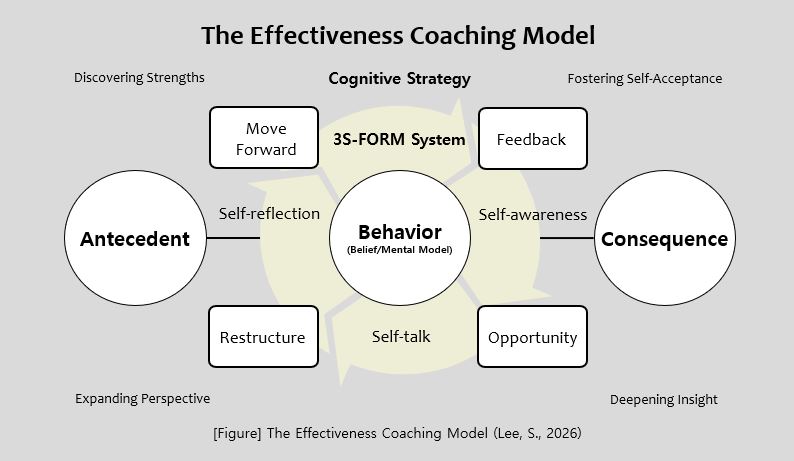
In the methodology developed by Dr. Sukjae Lee (이석재), the relationship between the ABC Framework and the 3S-FORM Model is one of Diagnosis versus Transformation. The ABC framework identifies the "what" and "why" of current behavior, while the 3S-FORM provides the "how" for psychological and behavioral reconstruction.
The theoretical foundation of the Effectiveness Coaching Methodology (Lee, 2014; 2019; 2025; 2026) is built on the integration of Behavioral Psychology (ABC) and Cognitive-Humanistic Coaching (3S-FORM).
1. The ABC Framework: The Diagnostic Foundation
The ABC framework—Antecedent, Behavior, Consequence—is rooted in functional behavior analysis. In Dr. Lee's methodology, it serves as the objective lens.
- The Theory: Behavior is not random; it is a response to environmental or internal triggers (A) and is maintained by the results it produces (C).
- The Coaching Function: It identifies the Critical Behavior that stands between the client’s current state and their desired "Effective Results."
2. The 3S-FORM Model: The Engine of Change
If the ABC framework diagnoses the external loop, the 3S-FORM model addresses the internal mechanics.
- 3S (The Inner Growth Engine): This represents the Cognitive Mediators. Between the Antecedent (A) and the Behavior (B) lies the client’s internal world—their Self-Awareness, Self-Talk, and Self-Reflection.
- FORM (The Process): This is the coach’s structural map to guide the client through the transition from the old "B" to a new, effective "B."
3. The Integration: How They Interlock
The relationship is best understood as a nested system where the 3S engine resides within the "B" (Behavior) of the ABC loop.
Phase 1: Breaking the Loop (ABC + F)
The relationship begins at the Feedback (F) stage of FORM. The coach uses the ABC framework to show the client the Consequence (C) of their current Behavior (B).
Theoretical Link: This creates the "Cognitive Dissonance" necessary for change. The client realizes their current ABC loop is "ineffective."
Phase 2: Internal Reconstruction (3S + R)
Once the loop is identified, the focus shifts to the 3S. Dr. Lee’s theory posits that to change the Behavior (B), one must first change the Self-Talk that occurs immediately after the Antecedent (A).
- Reframe (R): This is the specific point where the ABC and 3S meet. The coach helps the client Restructure and Reconstruct (as per your 2025 update) the internal narrative (Lee, 2026).
- The Shift: The Antecedent (A) stays the same, but the internal 3S engine processes it differently, leading to a new Behavior (B).
Phase 3: Validating the New Logic (M + C)
In the Move Forward (M) stage, the client implements the new behavior.
- The Result: This creates a new Consequence (C).
- The Reinforcement: According to the methodology, when the new behavior leads to an "Effective Result," it reinforces the new Self-Talk, making the change sustainable.
4. Summary of the Relationship
| Framework | Dimension | Primary Focus | Role in the Methodology |
| ABC | External/Behavioral | Functional Analysis | Identifies the "Target" for change. |
| 3S | Internal/Psychological | Cognitive Mediation | Powers the "Drive" for change. |
| FORM | Structural/Process | Facilitation Path | Coordinates the "Execution" of change. |
5. Academic Significance
Dr. Lee’s integration is significant because it moves coaching beyond simple "goal setting." By using ABC to ground the coaching in objective reality and 3S-FORM to drive subjective growth, the methodology ensures that "Effectiveness" is both a measurable outcome and a psychological state.
The 2025 refinement—specifically changing "Reframing" to "Restructuring and Reconstruction"—highlights that this isn't just a shift in perspective, but a fundamental rebuilding of the client’s mental model.
Reference
Lee, Sukjae (2025). The Dual-Engine Architecture of Effectiveness Coaching. https://thinkingpartner.co.kr/1448
Lee, Sukjae (2026). From Intrapsychic Healing to Collective Effectiveness: Restructuring Mental Models Through the 3S–FORM Architecture. https://coachall.tistory.com/1538
'3. 코칭심리연구 > 코칭심리 탐구' 카테고리의 다른 글
| Revisiting the Effetiveness Coaching (0) | 2026.03.03 |
|---|---|
| Understanding the 3S-FORM Model (0) | 2026.03.03 |
| 효과성 코칭의 내적 성장 엔진 (0) | 2026.03.01 |
| Understanding the "Dual Engines" of Effectiveness Coaching (0) | 2026.02.27 |
| “The Manager Who Hesitates to Coach” Through the Effectiveness Coaching Architecture (0) | 2026.02.27 |


