

| 일 | 월 | 화 | 수 | 목 | 금 | 토 |
|---|---|---|---|---|---|---|
| 1 | 2 | 3 | 4 | 5 | 6 | 7 |
| 8 | 9 | 10 | 11 | 12 | 13 | 14 |
| 15 | 16 | 17 | 18 | 19 | 20 | 21 |
| 22 | 23 | 24 | 25 | 26 | 27 | 28 |
- Effectiveness Coaching
- 떠도는 마음 사용법
- 결정적 행동
- 현징증심 코칭심리학
- 생각 파트너 이석재
- 효과성 코칭 모델
- 원하는 결과
- 씽킹 파트너
- Coach Sukjae Lee
- thinking partner
- 코칭방법론
- Effectiveness Coaching Methodology
- 코치올
- Sukjae Lee Ph.D.
- 관점 코칭
- 이종서 코치
- 증거기반코칭
- 코칭심리학 공부방
- 실행력을 높이는 코칭심리학 수업
- 코칭 프레임워크
- 관점 전환
- 효과성 코칭
- 현장중심 코칭심리학
- 효과성 프레임워크
- 효과성코칭워크숍
- Effectiveness Coaching Model
- 3S-FORM Coaching Model과 뇌과학의 결합
- 효과성 코칭 방법론
- 3S-FORM Coaching Model
- 경영심리학자의 효과성 코칭
- Today
- Total
코치올
Activating the Entrepreneurial Mindset: A 3S–FORM Application for Proactive Life and Leadership 본문
Activating the Entrepreneurial Mindset: A 3S–FORM Application for Proactive Life and Leadership
생각파트너 이석재 2026. 2. 27. 07:08Activating the Entrepreneurial Mindset: A 3S–FORM Application for Proactive Life and Leadership
Sukjae Lee, Coach
Developer of the Effectiveness Coaching Methodology
February 27, 2026
In a world where artificial intelligence increasingly replaces repetitive and instruction-based work, the core competitive advantage of human beings is no longer compliance. It is agency.
In my earlier message—“Design and create your life proactively”—I emphasized that we must live as active architects of our own lives (Lee, 2019). This does not require everyone to launch a venture. It requires an entrepreneurial mindset: thinking and acting with ownership.
To move from philosophy to practice, we need structure.
The 3S–FORM architecture, developed within the Effectiveness Coaching Methodology, provides a systematic pathway for activating and sustaining an entrepreneurial mindset—at the individual and organizational levels.
Entrepreneurship is not a personality trait.
It is a structured mode of thinking and execution.
I. Why Entrepreneurial Mindset Now?
Many people still pursue stability by entering large organizations and mastering existing routines. However, routines are increasingly automated. What remains irreplaceable is:
- Independent judgment
- Problem framing ability
- Opportunity recognition
- Collaborative innovation
- Responsibility ownership
Entrepreneurial mindset is the ability to engage reality proactively rather than reactively.
3S–FORM provides the mechanism to cultivate it (Lee, 2014; 2019).

II. 3S: Activating the Inner Entrepreneur
Entrepreneurship begins internally before it becomes externally visible.
1. Self-Awareness: Recognizing Personal Direction
Entrepreneurial activation begins with clarity:
- What do I genuinely want?
- What problems am I drawn to?
- What strengths distinguish me?
- What values shape my decisions?
Without self-awareness, individuals drift toward externally imposed expectations.
Self-awareness transforms a person from a task performer into a direction-setter.
Leaders can activate this by encouraging:
- Career reflection conversations
- Strength-mapping exercises
- Role-impact discussions
- Vision-alignment workshops
2. Self-Talk: Rewriting Internal Scripts
Passive script:
- “I will do what I’m assigned.”
- “If I follow instructions, I am safe.”
Entrepreneurial script:
- “What opportunity exists here?”
- “How can I improve this system?”
- “What value can I create?”
Internal dialogue shapes initiative.
Organizations that cultivate ownership language—rather than compliance language—accelerate entrepreneurial energy.
3. Self-Reflection: Converting Experience into Growth
Entrepreneurs do not simply act; they learn.
After projects, failures, or successes, ask:
- What did I discover?
- What assumption was incorrect?
- What new capability did I develop?
- What pattern is emerging?
Reflection prevents repeated mistakes and deepens competence.
Without reflection, experience accumulates without wisdom.
III. FORM: Structuring Entrepreneurial Execution
Inner activation must translate into disciplined action.
1. Feedback: Data Over Ego
Entrepreneurial mindset thrives on real feedback.
- Customer response
- Performance metrics
- Team perception
- Market indicators
Feedback reduces illusion and sharpens judgment.
Leaders must create feedback systems that are developmental rather than punitive.
2. Opportunity: Designing Growth Space
Entrepreneurship requires autonomy space.
Leaders activate opportunity by:
- Allowing experimentation time
- Assigning stretch projects
- Encouraging idea incubation
- Supporting calculated risk-taking
Opportunity signals trust.
Without opportunity, initiative collapses into routine.
3. Restructure: Redesigning Mental Models
Entrepreneurial activation often requires cognitive restructuring.
From:
- “My job is limited to my role.”
To:
- “My role is a platform for value creation.”
From:
- “Failure is dangerous.”
To:
- “Failure is feedback.”
Restructuring mental models prevents fear-based stagnation.
4. Move Forward: Embedding Initiative into Action
Entrepreneurship becomes visible when action follows insight.
- Launch pilot initiatives
- Test prototypes
- Initiate cross-functional collaboration
- Pursue knowledge deepening
Action stabilizes identity.
Without execution, entrepreneurship remains aspiration.
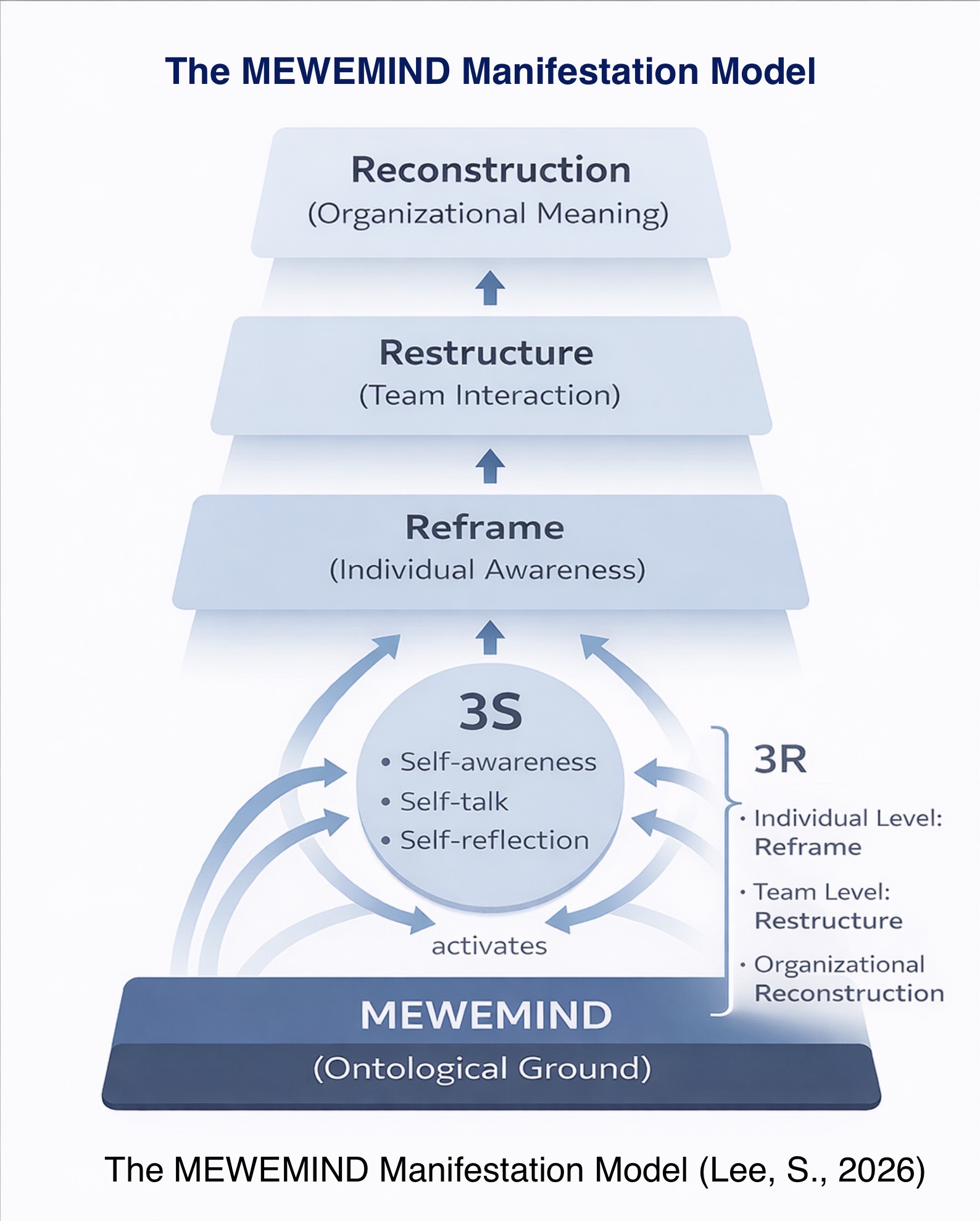
IV. The MEWEMIND Dimension
Entrepreneurial mindset is not isolated individualism.
It is ME operating within WE.
True entrepreneurial activation requires:
- Self-driven initiative
- Collaborative competence
- Shared value creation
Just as building a house requires both hammer and saw, specialized expertise must integrate with collective effort.
Entrepreneurship without collaboration creates fragmentation.
Collaboration without ownership creates stagnation.
V. Leadership Implications
Leaders must shift from:
Controlling execution
to
Marketing growth.
This means asking:
- What work will help this person grow?
- How can we align personal aspiration with organizational strategy?
- How can we cultivate ownership rather than dependency?
Entrepreneurial leaders build systems that produce entrepreneurs.
VI. Organizational Activation Model
| Stage | Individual Activation | Leadership Role |
| 3S – Awareness | Clarify purpose | Facilitate meaning alignment |
| 3S – Narrative | Ownership thinking | Reinforce initiative language |
| 3S – Reflection | Learning integration | Structure debrief cycles |
| FORM – Feedback | Reality calibration | Provide transparent metrics |
| FORM – Opportunity | Autonomy | Design experimentation space |
| FORM – Restructure | Mental flexibility | Remove structural barriers |
| FORM – Move Forward | Execution | Reward proactive behavior |
VII. Responsibility as the Core
Entrepreneurial mindset is fundamentally responsibility-centered.
If someone else dictates your direction, accountability weakens.
If you design your direction, responsibility strengthens.
Leadership begins with responsibility (Lee, 2014; 2019).
Entrepreneurship is responsibility operationalized.
VIII. Final Perspective
The future will not reward compliance.
It will reward agency.
Living proactively is not a motivational slogan.
It is a structured discipline.
3S activates inner ownership.
FORM stabilizes execution.
MEWEMIND anchors relational integration.
Together, they cultivate individuals who do not wait for instruction—but design, initiate, collaborate, and build.
That is the entrepreneurial mindset required for the age ahead.
Final Message
Do not wait for the future to happen.
Design it.
Do not wait for opportunity to appear.
Create it.
Do not wait for leadership.
Become it.
The future belongs not to the compliant,
but to the proactive.
Reference
Lee, Sukjae (2014). Effectiveness Coaching by a Business Psychologist. Seoul: Kim & Kim Books.
Lee, Sukjae (2019). Thought Revolution That Changes My Life. Seoul: Wildbooks.
Lee, Sukjae (2026). Definition of MEWEMIND. https://mewemind.tistory.com/72
'3. 코칭심리연구 > 코칭심리 탐구' 카테고리의 다른 글
| Design and Create Your Life Proactively (0) | 2026.02.27 |
|---|---|
| Activating Employee Engagement Through Relational Leadership (0) | 2026.02.26 |
| Team-Level Engagement Activation Model (0) | 2026.02.26 |
| 3S–FORM Engagement Activation Framework: Converting Employee Engagement into Executional Effectiveness (0) | 2026.02.26 |
| Driving Employee Engagement (0) | 2026.02.26 |


