| 일 | 월 | 화 | 수 | 목 | 금 | 토 |
|---|---|---|---|---|---|---|
| 1 | 2 | 3 | ||||
| 4 | 5 | 6 | 7 | 8 | 9 | 10 |
| 11 | 12 | 13 | 14 | 15 | 16 | 17 |
| 18 | 19 | 20 | 21 | 22 | 23 | 24 |
| 25 | 26 | 27 | 28 | 29 | 30 | 31 |
- 원하는 결과
- Effectiveness Coaching Methodology
- thinking partner
- 코치올
- Sukjae Lee Ph.D.
- 관점 코칭
- 경영심리학자의 효과성 코칭
- 코칭심리학 공부방
- 실행력을 높이는 코칭심리학 수업
- 떠도는 마음 사용법
- 결정적 행동
- 현징증심 코칭심리학
- 3S-FORM Coaching Model
- Effectiveness Coaching
- 효과성 코칭 모델
- 관점 전환
- 3S-FORM Coaching Model과 뇌과학의 결합
- 현장중심 코칭심리학
- 이종서 HR 컨설턴트
- 씽킹 파트너
- 미위마인드 mewemind.com
- 생각 파트너 이석재
- Coach Sukjae Lee
- 이종서 코치
- Effectiveness Coaching Model
- 효과성 코칭
- 코칭방법론
- 멘탈 모델링 코칭
- 효과성 코칭 방법론
- 증거기반코칭
- Today
- Total
생각 파트너
Team-Level Engagement Activation Model 본문
Team-Level Engagement Activation Model
Sukjae Lee
Creator of the Effectiveness Coaching Methodology
February 26, 2026
We can elevate engagement from an individual construct to a team-level activation system.
At the team level, engagement is not merely enthusiasm or effort.
It is the degree to which team members (Lee, S., 2014; 2020):
- Cognitively internalize shared goals
- Emotionally attach to collective purpose
- Behaviorally invest discretionary energy
This model integrates:
- The three engagement components (cognition–emotion–behavior)
- The 3S inner activation engine
- The FORM execution architecture
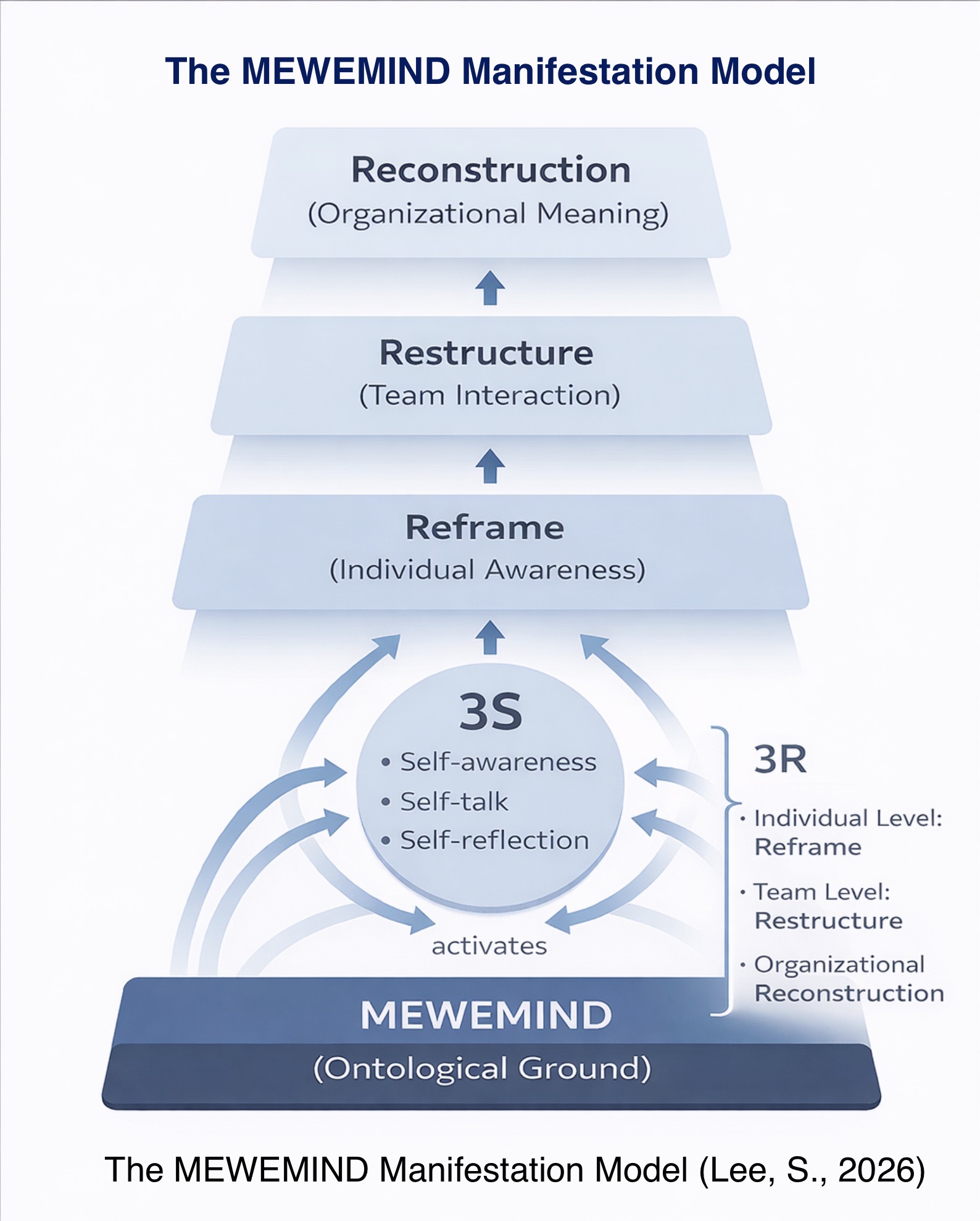
- The MEWEMIND principle (ME within WE)
I. Structural Foundation
Engagement at Team Level Emerges When:
ME → Internalizes WE → Executes with Ownership
At the team level, engagement becomes:
Shared psychological ownership + coordinated behavioral energy.
II. The Three-Stage Team Engagement Activation Model
Stage 1 – Shared Meaning Alignment (3S: Self-Awareness Expansion)
Objective:
Ensure that each team member understands how their role connects to team and organizational goals.
Leader Actions:
- Clarify the team’s purpose in strategic language.
- Translate high-level goals into team-specific impact.
- Conduct “role-to-impact” mapping sessions.
Team Dialogue Questions:
- How does our work contribute to the organization’s vision?
- What happens if our function underperforms?
- Where do we create the greatest value?
Outcome:
Cognitive ownership increases.
Team members begin perceiving themselves as contributors, not task executors.
Stage 2 – Psychological Ownership Activation (3S: Self-Talk + Reflection)
Objective:
Shift internal narratives from compliance to ownership.
Common Low-Engagement Scripts:
- “Management decided this.”
- “This is just my assignment.”
- “I’m responsible only for my piece.”
Engagement-Oriented Scripts:
- “We are accountable for this outcome.”
- “My initiative influences team success.”
- “Our collaboration shapes results.”
Leader Practices:
- Encourage opinion-sharing on work-impact issues.
- Facilitate structured reflection after major milestones.
- Publicly reinforce initiative behaviors.
Outcome:
Emotional attachment strengthens.
Team identity begins forming.
Stage 3 – Structural Enablement (FORM Activation)
Engagement deteriorates if structural barriers persist.
Feedback
- Provide transparent team performance metrics.
- Share progress dashboards.
- Review contribution impact regularly.
Opportunity
- Rotate leadership responsibilities in projects.
- Provide stretch assignments.
- Create innovation windows.
Restructure
If engagement declines, assess structural issues:
- Are decision rights unclear?
- Is workload distribution imbalanced?
- Are processes bureaucratically restrictive?
Redesign accordingly.
Move Forward
- Assign collective ownership goals.
- Encourage proactive problem-solving.
- Reward cross-functional collaboration.
Outcome:
Engagement becomes embedded into execution.
III. Team Engagement Diagnostic Matrix
| Symptom | Likely 3S Breakdown | Likely FORM Breakdown | Intervention |
| Passive participation | Weak role meaning | Limited autonomy | Clarify impact + expand decision latitude |
| Burnout | Identity misalignment | Workload imbalance | Redistribute load + re-anchor purpose |
| Minimal initiative | Compliance mindset | No growth pathway | Introduce opportunity structure |
| Strategic confusion | Goal ambiguity | Feedback inconsistency | Reinforce communication cadence |
IV. MEWEMIND Integration at Team Level
Team engagement accelerates when members experience:
“My success is intertwined with our success.”
MEWEMIND encourages leaders to cultivate:
- Mutual accountability
- Relational respect
- Shared identity
- Psychological safety
Instead of “I perform,”
the team shifts to “We create results.”
This shift transforms engagement from personal energy into collective momentum.
V. Leadership Behaviors That Sustain Team Engagement
Derived from Driving Employee Engagement (Lee, S., 2026), adapted to team scale:
- Treat team members with attentiveness and respect.
- Invite voice in decisions affecting work processes.
- Focus on improving processes rather than increasing control.
- Provide autonomy with clear accountability boundaries.
- Recognize contributions consistently.
- Offer developmental challenges aligned with growing competence.
- Shape culture intentionally around shared vision and goals.
VI. Engagement Energy Flow at Team Level
The engagement energy cycle becomes:
Shared Meaning → Ownership → Emotional Attachment → Autonomy → Initiative → Results → Reinforced Identity
When the cycle is stable, the team becomes self-propelling.
VII. Maturity Levels of Team Engagement
| Level | Team Experience | Leadership Style | Sustainability |
| Compliance | Task execution | Directive | Fragile |
| Commitment | Goal alignment | Supervisory | Moderate |
| Engagement | Ownership | Empowering | High |
| Collective Identity | Shared authorship | Systemic | Transformational |
The highest level reflects full ME–WE integration.
VIII. Implementation Roadmap for Leaders
Phase 1 – Diagnose
- Conduct team engagement pulse survey.
- Map cognitive–emotional–behavioral indicators.
Phase 2 – Align
- Clarify shared purpose.
- Recalibrate role definitions.
Phase 3 – Enable
- Redesign structural bottlenecks.
- Increase autonomy boundaries.
Phase 4 – Reinforce
- Establish reflection cadence.
- Celebrate initiative behaviors.
- Track engagement-linked KPIs.
Closing Perspective
Team-level engagement is not a morale boost.
It is structured ownership at scale.
When:
3S activates shared awareness,
FORM stabilizes execution,
MEWEMIND anchors relational identity,
engagement transforms from individual enthusiasm
into collective strategic acceleration.
Reference
'4. 코칭심리연구 > 코칭심리 탐구' 카테고리의 다른 글
| Activating the Entrepreneurial Mindset (0) | 2026.02.27 |
|---|---|
| Design and Create Your Life Proactively (0) | 2026.02.27 |
| 3S–FORM Engagement Activation Framework: Converting Employee Engagement into Executional Effectiveness (0) | 2026.02.26 |
| Driving Employee Engagement (0) | 2026.02.26 |
| Integration with the 3S–FORM Execution Architecture: Applying MEWEMIND to Failure in Leadership Practice (0) | 2026.02.15 |


