

| 일 | 월 | 화 | 수 | 목 | 금 | 토 |
|---|---|---|---|---|---|---|
| 1 | 2 | 3 | 4 | 5 | 6 | 7 |
| 8 | 9 | 10 | 11 | 12 | 13 | 14 |
| 15 | 16 | 17 | 18 | 19 | 20 | 21 |
| 22 | 23 | 24 | 25 | 26 | 27 | 28 |
- 떠도는 마음 사용법
- 관점 전환
- 효과성 코칭 방법론
- 현징증심 코칭심리학
- 3S-FORM Coaching Model
- 경영심리학자의 효과성 코칭
- 코칭 프레임워크
- 효과성코칭워크숍
- 결정적 행동
- Effectiveness Coaching Model
- 코칭심리학 공부방
- 이종서 코치
- Sukjae Lee Ph.D.
- 코칭방법론
- 3S-FORM Coaching Model과 뇌과학의 결합
- 코치올
- Coach Sukjae Lee
- 효과성 프레임워크
- 효과성 코칭 모델
- 실행력을 높이는 코칭심리학 수업
- 원하는 결과
- Effectiveness Coaching Methodology
- 현장중심 코칭심리학
- 관점 코칭
- thinking partner
- Effectiveness Coaching
- 씽킹 파트너
- 생각 파트너 이석재
- 증거기반코칭
- 효과성 코칭
- Today
- Total
코치올
A Revolution of Thought That Transforms Your Life 본문
A Revolution of Thought That Transforms Your Life
Sukjae Lee, Ph.D.
Creator of the Effectiveness Coaching Methodology
January 17, 2026
We are living in an era defined by change, innovation, creativity, and initiative. With the rapid advancement of information technology and AI, standardized tasks have been systemized and automated. Speed and accuracy in routine work are no longer the primary source of competitive advantage.
What truly matters now is not doing things faster, but reading change, thinking creatively, and generating innovation. In the 21st century, competitiveness is determined by how quickly meaningful value can be created. The most valuable people today are those who can think. This is where coaching begins.
A coach is a thinking partner—someone who stimulates people’s thinking so they can design and lead their own lives with intention.
1. Developing Effectiveness Coaching: Helping People Change How They Think and Act
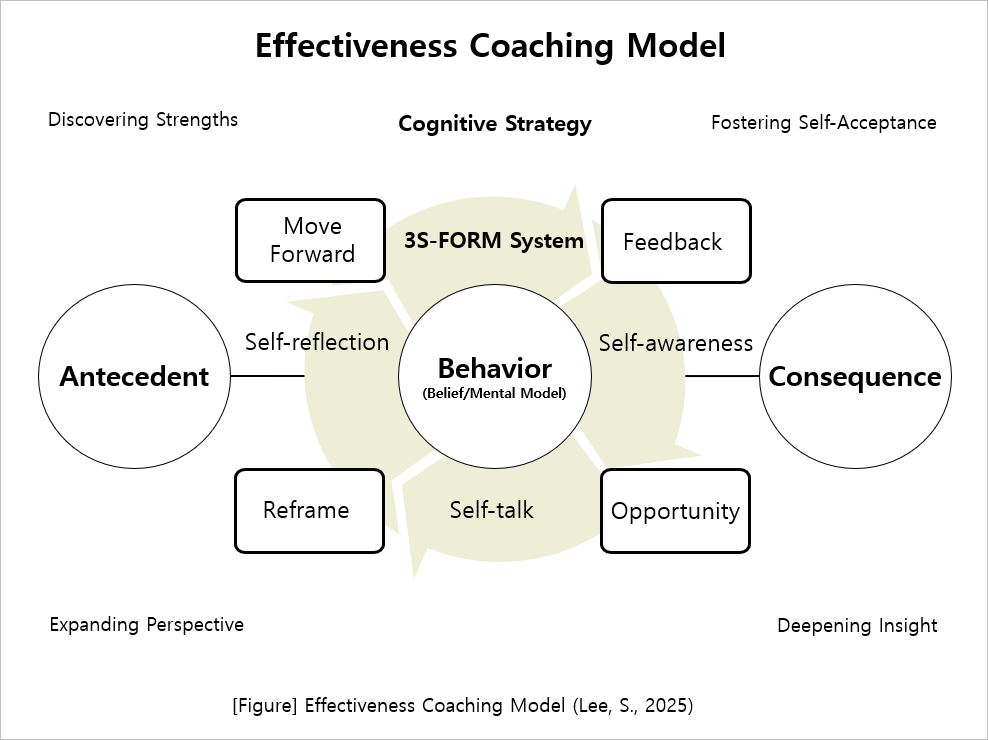
From 2002 to 2018, I analyzed extensive coaching dialogue notes and journals from my work with organizational leaders. Through this long-term analysis, I identified seven core change demands that repeatedly appeared in leaders’ lives. I came to see these seven demands not simply as coaching topics, but as the central life themes leaders struggle with. Meaningful change does not occur solely within the coachee’s mindset. When a coachee brings a desire for change, the coach must bring a cognitive strategy that helps translate that desire into real behavioral change. I call this approach cognitive strategies for reframing thinking.
Based on four such strategies, I developed the 3S–FORM Coaching Model, a structured process designed to help people change the way they think, act, and ultimately achieve results. By integrating my background in managerial psychology, corporate consulting, executive coaching, and diagnostic tool development, I later expanded this work into a comprehensive methodology—Effectiveness Coaching—focused on helping individuals and organizations achieve desired results (called "Effective Results") through change.
This book introduces the Effectiveness Coaching Model for the first time in a complete and integrated way.(see [Figure]). The answer to any problem already exists within the individual. The role of the coach is not to provide answers, but to help people discover them. Effectiveness Coaching works by stimulating thinking, enabling behavioral change, and guiding people toward outcomes they truly want. In this book, I connect change demands, cognitive strategies, and the 3S–FORM model—supported by theory and real coaching cases—into one coherent framework.
2. From Being to Doing: How Change Really Happens Today
We now live in a hyper-connected world driven by innovation, convergence, big data, artificial intelligence, and global networks. In this environment, speed is everything—but where does that speed come from?
In the industrial age, execution (doing) was fueled by discipline, imitation, and hard work. Today, execution is fueled by being.
What drives action now is not pressure, but:
- intrinsic motivation,
- awareness of one’s change demands,
- recognition of one’s potential,
- and deep self-awareness.
True execution emerges naturally when being is aligned.
3. Awakening Self-Awareness to Design the Life You Want
At the foundation of all change lies self-awareness. Since 2002, I have conducted over 3,500 hours of coaching in accordance with International Coaching Federation (ICF) standards. Through countless encounters with individuals and organizational leaders, I have learned one essential truth:
People believe they know themselves—but what they truly want is to know themselves better. They want to change how they think and act. They wonder which part of themselves must change. Ironically, the people who influenced their lives the most were often others. Why can’t we become the most influential person in our own lives?
Those who succeeded in leading change did not find answers outside themselves. They discovered those answers through self-awareness—and that awakening often began through coaching. A thinking partner supports people when they step forward as the main character of their own lives, helping them strengthen self-belief and move forward with clarity.
4. An Invitation to Meet Yourself—Here and Now
This book is structured in three parts.
Part 1: Designing Effective Results
Introduces the Effectiveness Coaching Model, its components, and real coaching cases based on seven core change demands identified through leadership coaching. Readers experience the psychological reality of leaders striving for meaningful results.
Part 2: Strategies for Fundamental Change in Being
Explores four cognitive strategies and a step-by-step coaching approach that connects change demands to decisive action. Real coaching cases illustrate why many well-intentioned plans fail—and how identifying critical behaviors makes success more likely.
Part 3: Completing Change Through a Systemic Process
Details how coachees experience shifts in thinking and behavior through the structured 3S–FORM coaching process. It explains the FORM dialogue flow and the coachee’s internal 3S activities—self-awareness, self-talk, and self-reflection—along with practical coaching tools.
5. Let Being Activate Doing
This book is the first in Korea to deeply analyze change demands embedded in coaching themes and present an evidence-based Effectiveness Coaching Model grounded in psychology.
It is written for:
- professional coaches and internal coaches,
- HR and talent development professionals,
- counselors and aspiring coaches,
- and anyone interested in self-leadership and personal growth.
The 21st century is the age of thinking partners. It is a human-centered era where being activates doing, and self-awareness is the most fundamental resource for change. As you read this book, you will encounter questions and tools that help you rediscover your potential, your authentic self, and your change demands.
You may realize that you are living in an era where you are finally stepping onto the center stage of your own life.
Stay awake.
Reflect deeply.
And consciously create the life you truly want.
References
Lee, Sukjae (2006). Develop 18 Core Leadership Competencies. Seoul: Kim & Kim Books.
Lee, Sukjae (2014). Effectiveness Coaching by a Business Psychologist. Seoul: Kim & Kim Books.
Lee, Sukjae (2019). Thought Revolution That Changes My Life. Seoul: Wildbooks.
Lee, Sukjae (2020). Coaching Methodology. Seoul: Korea Coaching Supervision.
Lee, Sukjae (2020). How to Use a Wandering Mind. Seoul: Plan B Design.
Lee, Sukjae (2023). Field-Focused Coaching Psychology. Seoul: Hakjisa.
Lee, Sukjae (2024). Coaching Psychology Class for Boosting Execution. Seoul: Hakjisa.
Lee, Sukjae (2024). Thinking Partner. Gyeonggi: Moa Books.
Lee, Sukjae & Lee, Jongseo (2025). Perspective Shifting. Seoul: Parkyoungstory.
'3. 코칭심리연구 > 코칭심리 탐구' 카테고리의 다른 글
| 멘털 모델링 코칭과 슬로건 (0) | 2026.01.23 |
|---|---|
| 주체적인 삶의 변화 설계자 (0) | 2026.01.20 |
| 코치로서 내가 걸어 온 길 (0) | 2026.01.14 |
| Critical Perspective Shifting as an Inner Growth Mechanism (0) | 2026.01.10 |
| 변화를 돕는 효과성 코칭 (0) | 2026.01.10 |


