
| 일 | 월 | 화 | 수 | 목 | 금 | 토 |
|---|---|---|---|---|---|---|
| 1 | 2 | 3 | ||||
| 4 | 5 | 6 | 7 | 8 | 9 | 10 |
| 11 | 12 | 13 | 14 | 15 | 16 | 17 |
| 18 | 19 | 20 | 21 | 22 | 23 | 24 |
| 25 | 26 | 27 | 28 | 29 | 30 | 31 |
- 효과성 코칭 모델
- 결정적 행동
- 3S-FORM Coaching Model과 뇌과학의 결합
- 현장중심 코칭심리학
- 코치올
- Effectiveness Coaching Methodology
- 관점 코칭
- 경영심리학자의 효과성 코칭
- 실행력을 높이는 코칭심리학 수업
- 증거기반코칭
- 떠도는 마음 사용법
- Coach Sukjae Lee
- Effectiveness Coaching
- 멘탈 모델링 코칭
- 효과성 코칭
- 생각 파트너 이석재
- 원하는 결과
- 미위마인드 mewemind.com
- 현징증심 코칭심리학
- Effectiveness Coaching Model
- 효과성 코칭 방법론
- 씽킹 파트너
- 관점 전환
- thinking partner
- 코칭방법론
- 코칭심리학 공부방
- Sukjae Lee Ph.D.
- 이종서 코치
- 3S-FORM Coaching Model
- 이종서 HR 컨설턴트
- Today
- Total
생각 파트너
Mental Modeling in the MEWEMIND Framework: A Systemic Approach to Cognitive and Relational Architecture 본문
Mental Modeling in the MEWEMIND Framework: A Systemic Approach to Cognitive and Relational Architecture
Thinking Partner 2026. 5. 9. 20:02Mental Modeling in the MEWEMIND Framework: A Systemic Approach to Cognitive and Relational Architecture
Sukjae Lee, Ph.D.
Creator of the Mental Modeling Coaching
May 9, 2026
Abstract
The MEWEMIND framework posits that human behavior is not fundamentally stochastic; rather, it is the deterministic output of deeply embedded, invisible mental structures. The core operational construct of this framework—mental modeling—investigates how latent internal paradigms shape human interpretations of reality, decision-making processes, relational dynamics, and systemic outcomes. This article examines the ontology, etiology, and systemic implications of mental models, arguing that sustainable behavioral and organizational change necessitates structural cognitive redesign rather than superficial behavioral modification.
1. Introduction: The Ontology of Mental Models
At its foundation, MEWEMIND interrogates a critical psychological question: What invisible internal models shape how individuals interpret reality and generate outcomes? A mental model operates as an internal, heuristic map of reality. The framework operates on the epistemological premise that human beings do not interact with objective reality directly. Instead, individuals interface with a mediated reality constructed of interpretations, assumptions, expectations, narratives, and symbolic meanings. Mental models serve as the scaffolding for these interpretations.
Consider the differential processing of critical feedback. When exposed to identical stimuli, Subject A’s mental model ("Criticism facilitates growth") generates epistemic curiosity and calm reflection. Subject B’s model ("Criticism equates to relational rejection") triggers defensive affect, shame, and hostility. The objective event is identical, but divergent cognitive models generate distinct phenomenological realities. Therefore, the primary objective of MEWEMIND is the identification and transformation of these hidden cognitive structures.
2. The Fallacy of Surface-Level Intervention
A fundamental axiom of MEWEMIND is that observable behavior is generated by underlying meaning systems. Consequently, surface-level interventions often fail because they leave the foundational mental architecture intact.
When organizations implement "collaboration training" while sustaining a hidden collective mental model that "only individual performance is rewarded," the training inevitably fails. The invisible cognitive model consistently overrides the explicit, visible directive. In this context, mental modeling is the application of classic systems thinking to individual and organizational psychology.
3. The Invisibility and Etiology of Mental Models
One of the most critical insights of the MEWEMIND philosophy is the unconscious nature of mental models. These frameworks become automatized, emotionally embedded, and socially reinforced to the extent that individuals conflate their subjective interpretations with objective "reality." This epistemic blind spot is precisely what makes cognitive restructuring challenging.
MEWEMIND conceptualizes mental models as emerging from a multi-layered etiology:
- Familial Conditioning: Early relational environments encode subconscious operating systems (e.g., "Achievement earns love," "Conflict is existentially dangerous").
- Macro-Cultural Systems: Broad sociocultural environments install shared cognitive defaults, dictating norms around competition, hierarchy, gender roles, and collectivism.
- Organizational Culture: Institutional environments forge localized models (e.g., "Failure is punished," "Busyness equates to value") which dictate behavior far more effectively than official corporate policy.
- Idiosyncratic Experience: Repeated personal exposures to success, trauma, or exclusion reinforce deeply held identity beliefs.
4. The Structural Mechanics of Reality Construction
Mental models are not monolithic; they possess a distinct, multi-layered causal structure. The MEWEMIND framework traces this progression sequentially:
- Assumption: A foundational belief (e.g., "People cannot be trusted").
- Meaning Assignment: A contextual interpretation (e.g., "Vulnerability is therefore unsafe").
- Emotional Coding: The affective response (e.g., Fear/Anxiety).
- Behavioral Output: The observable action (e.g., Avoidance, over-control).
- Social Effect: The systemic outcome (e.g., Weakened interpersonal relationships).
This sequence highlights how mental models actively construct reality via self-reinforcing feedback loops. Because these models dictate attention, memory retrieval, and emotional prediction, an individual operating under the assumption that "people judge me" will demonstrate hyper-vigilance toward perceived criticism while disregarding cues of acceptance. The resulting defensive behavior generates genuine social distance, thereby confirming and reinforcing the original distorted model.
5. Organizational Mental Modeling: Systems within Minds
MEWEMIND extends mental modeling beyond individual psychology into the realm of collective phenomena. Organizations inevitably operate under the influence of hidden shared assumptions, such as "Innovation is too risky" or "Silence is safer than honesty." These invisible collective beliefs dictate decision-making, creativity, and leadership culture far more potently than explicit strategic objectives.
Crucially, the MEWEMIND approach distinguishes itself from the superficial paradigms of "positive thinking." It eschews motivational slogans and forced optimism in favor of structural awareness-the rigorous, objective analysis of hidden assumptions and the conscious redesign of those frameworks.
6. Identity as a Cognitive Construct and the "ME to WE" Paradigm
A profound dimension of this framework is the conceptualization of identity itself as a mental model. Subconscious frameworks such as "I am valuable only when productive" or "I am fundamentally isolated" dictate lifetime behavioral patterns. MEWEMIND facilitates the observation, deconstruction, and reconstruction of these identity systems.
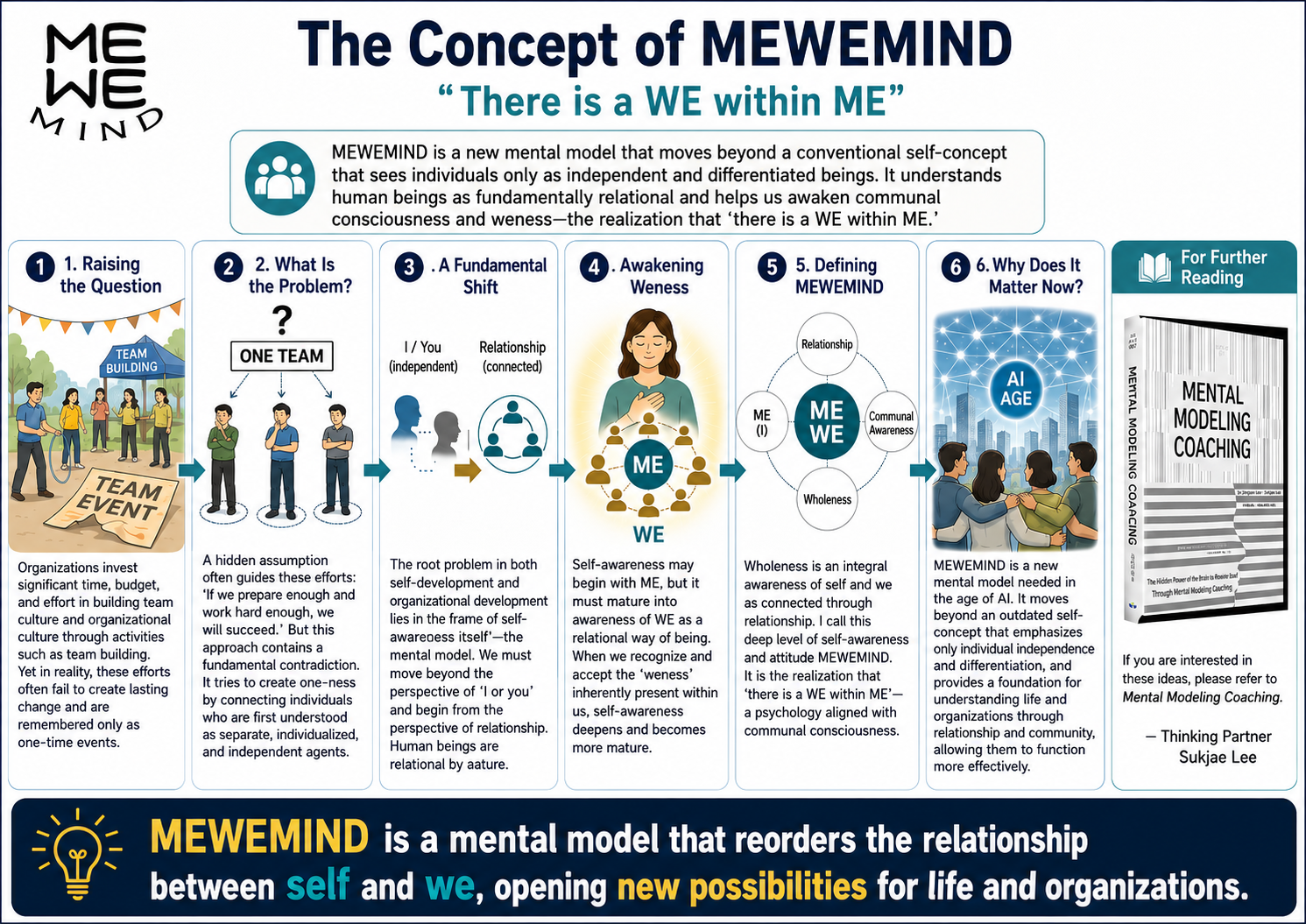
This connects to the overarching philosophy of the framework: the transition from "ME" to "WE." Because mental models are heavily inherited through social and cultural transmission, the concept of the "self" is recognized as a collectively constructed entity. Transformation, therefore, cannot be reduced to isolated self-improvement. It demands a systemic understanding of relationships and collective meaning structures. This operationalizes the psychological concept that "the ME contains the WE."
7. Theoretical Intersections and Coaching Praxis
The MEWEMIND model situates itself at the nexus of several established disciplines:
- Cognitive Behavioral Therapy (CBT): Sharing an emphasis on identifying thought patterns, but expanding into broader systemic and relational territories.
- Systems Theory: Focusing on the hidden architectures that generate systemic outcomes.
- Jungian Depth Psychology: Paralleling the pursuit of uncovering unconscious behavioral drivers.
- Buddhist Epistemology: Echoing the practice of objectively observing conditioned mental formations.
In applied coaching contexts, the MEWEMIND methodology progresses through a systematic five-step praxis:
- Observation of Outcomes: Identifying systemic symptoms (conflict, burnout, leadership attrition).
- Identification of Behavioral Patterns: Mapping recurring actions (avoidance, perfectionism).
- Discovery of Underlying Models: Excavating the latent assumptions driving the behavior.
- Tracing Systemic Reinforcement: Understanding how family, culture, and workplace validate the model.
- Conscious Reconstruction: Replacing maladaptive assumptions with reality-aligned, relationally sound cognitive frameworks.
8. Conclusion
The most profound premise of the MEWEMIND framework is the recognition that human beings do not merely reside within external systems; rather, individuals carry the architecture of systems-culture, history, relational dynamics, and collective beliefs-inside their minds. Attempting to alter human behavior through simple directive instruction is inherently flawed. Sustainable transformation demands the excavation and conscious redesign of the hidden cognitive and relational frameworks that generate our individual and collective realities.
Reference
Jongseo Lee & Sukjae Lee (2026). Mental Modeling Coaching. Coaching Books.

'4. 코칭심리연구 > 코칭심리 탐구' 카테고리의 다른 글
| 멘탈 모델링 코칭-후속편 집필 (0) | 2026.05.22 |
|---|---|
| How Lee & Lee relate to the broader mental-models tradition Kenneth Craik, 1943 (0) | 2026.05.16 |
| 미위마인드(mewemind) 개념 (0) | 2026.05.07 |
| The Concept of MEWEMIND (0) | 2026.05.07 |
| 코칭 실행자와 탐구자 (0) | 2026.05.05 |


