

| 일 | 월 | 화 | 수 | 목 | 금 | 토 |
|---|---|---|---|---|---|---|
| 1 | 2 | 3 | 4 | 5 | 6 | 7 |
| 8 | 9 | 10 | 11 | 12 | 13 | 14 |
| 15 | 16 | 17 | 18 | 19 | 20 | 21 |
| 22 | 23 | 24 | 25 | 26 | 27 | 28 |
| 29 | 30 | 31 |
- 씽킹 파트너
- 코치올
- 관점 코칭
- thinking partner
- 코칭방법론
- Coach Sukjae Lee
- Sukjae Lee Ph.D.
- 증거기반코칭
- 미위마인드 mewemind.com
- 관점 전환
- 현장중심 코칭심리학
- 경영심리학자의 효과성 코칭
- 효과성 코칭 모델
- 실행력을 높이는 코칭심리학 수업
- 원하는 결과
- 생각 파트너 이석재
- 현징증심 코칭심리학
- 코칭 프레임워크
- 3S-FORM Coaching Model과 뇌과학의 결합
- 효과성 코칭 방법론
- 3S-FORM Coaching Model
- Effectiveness Coaching Model
- Effectiveness Coaching
- Effectiveness Coaching Methodology
- 코칭심리학 공부방
- 이종서 코치
- 결정적 행동
- 효과성 코칭
- 떠도는 마음 사용법
- 효과성 프레임워크
- Today
- Total
코치올
Crisis Leadership Model: Integrating MEWEMIND with 3S–FORM Execution Architecture 본문
Crisis Leadership Model: Integrating MEWEMIND with 3S–FORM Execution Architecture
생각파트너 이석재 2026. 2. 16. 03:38Crisis Leadership Model: Integrating MEWEMIND with 3S–FORM Execution Architecture
Sukjae Lee, Ph.D.
Creator of the Effectiveness Coaching Methodology
February 16, 2026
Crisis exposes the true structure of leadership.
Under pressure, leaders default to their dominant cognitive pattern—often execution-first, evaluation-heavy, and ego-protective. In performance-driven systems, this frequently produces rapid blame allocation, defensive communication, and superficial correction.
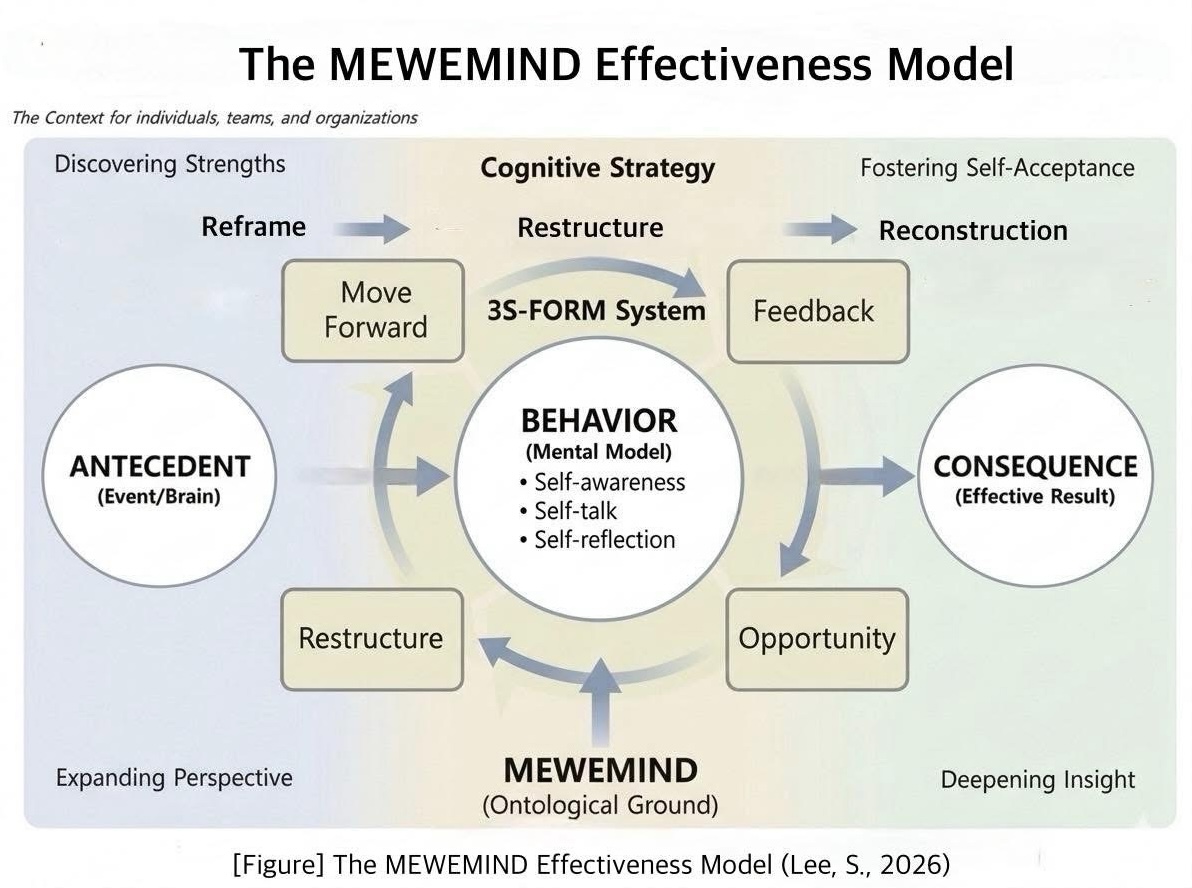
A crisis leadership model grounded in MEWEMIND (ME within WE) and operationalized through the 3S–FORM execution architecture—as articulated within the Effectiveness Coaching Methodology developed by Dr. Lee Suk-Jae—provides a disciplined alternative.
This model transforms crisis from reputational threat into systemic recalibration.
I. Core Premise of the Model
Crisis is not merely an event failure. It is a rupture in the relational and systemic field between ME (leader) and WE (organization) (Lee, S. 2026).
Therefore, crisis response must occur at two levels simultaneously (Lee, S., 2014; 2020; 2024; 2025):
- Internal stabilization (3S)
- External structural intervention (FORM)
II. The Four-Phase Crisis Leadership Architecture
Phase 1: Stabilize the Leader (3S Activation)
Before public action, the leader must stabilize internally.
1) Self-Awareness
Recognize immediate internal reactions:
- Fear of loss of authority
- Anxiety about public perception
- Urgency to control narrative
- Defensive impulse
Question:
- What emotion is currently driving my interpretation?
This prevents reactive escalation.
2) Self-Talk
Interrupt automatic scripts:
Reactive script:
- “We must protect the organization immediately.”
- “Someone must be held accountable.”
Restructured script:
- “We must first understand what happened.”
- “Stability precedes attribution.”
Language determines culture tone.
3) Self-Reflection
Integrate ME within WE:
- How might my prior leadership decisions have shaped this system?
- What pressures influenced operational shortcuts?
- Where might psychological safety have been insufficient?
Reflection reduces ego-protective distortion.
III. Phase 2: Systemic Clarity (Feedback)
Once stabilized, activate structured feedback.
- Reconstruct event timeline
- Gather cross-functional data
- Conduct confidential stakeholder interviews
- Identify decision nodes
Principle:
Data before declaration.
Public messaging should not precede internal clarity.
IV. Phase 3: Structural Recalibration (Opportunity + Restructure)
Crisis presents leverage.
Opportunity Framing
Instead of:
“Who failed?”
Ask:
“What systemic assumptions failed?”
Restructure Actions
- Redesign oversight checkpoints
- Clarify escalation protocols
- Strengthen early-warning mechanisms
- Recalibrate incentive structures
- Adjust communication transparency norms
Crisis is a signal of structural misalignment.
Restructure prevents repetition (Lee, S., & Lee, J. 2025).
V. Phase 4: Disciplined Forward Movement (Move Forward)
Execution anchors learning.
- Announce structural changes transparently
- Clarify shared accountability
- Establish monitoring metrics
- Reinforce speak-up culture
- Schedule follow-up audits
Execution converts insight into institutional memory.
VI. Crisis Leadership Maturity Levels
| Level | Reaction Pattern | Cultural Outcome |
| 1. Reactive | Blame & containment | Fear & silence |
| 2. Tactical | Surface correction | Temporary stability |
| 3. Developmental | Process redesign | Adaptive capacity |
| 4. Systemic (MEWEMIND × 3S–FORM) | Ontological + structural integration | Organizational maturity |
The highest maturity level integrates being and doing.
VII. Communication Framework During Crisis
Communication must align with structure.
1) Internal Messaging
- Acknowledge event
- Commit to transparency
- Separate accountability from condemnation
- Invite information flow
2) External Messaging
- Express responsibility
- Clarify investigation process
- Avoid premature conclusions
- Demonstrate structured action plan
Tone determines psychological climate.
VIII. Indicators of Effective Crisis Leadership
When MEWEMIND × 3S–FORM is functioning:
- Emotional escalation stabilizes quickly
- Rumor intensity decreases
- Self–other perception gap narrows
- Reporting transparency increases
- Repeat incident probability declines
Effectiveness is not measured by absence of crisis.
It is measured by response maturity.
IX. Executive Crisis Reflection Protocol
When crisis emerges, leaders should ask:
- What internal reaction must I regulate first?
- What relational field has been disrupted?
- What systemic assumption failed?
- What structural redesign is required?
- How will we embed learning institutionally?
This protocol transforms crisis from ego threat into structural evolution.
X. Final Integration
Crisis often triggers regression into isolated ME.
Mature crisis leadership expands ME into WE.
Through 3S stabilization and FORM execution:
Crisis → Awareness → Systemic Clarity → Structural Redesign → Institutional Strengthening
Resilience is recovery.
Maturity is redesign.
The difference defines sustainable leadership.
References
Lee, Sukjae (2014). Effectiveness Coaching by a Business Psychologist. Seoul: Kim & Kim Books.
Lee, Sukjae (2020). Coaching Methodology. Seoul: Korea Coaching Supervision.
Lee, Sukjae (2024). Coaching Psychology Class for Boosting Execution. Seoul: Hakjisa.
Lee, Sukjae (2025). Strength-Based Effectiveness Coaching. https://coachall.tistory.com/1475
Lee, Sukjae, & Lee, Jongseo (2025). Perspective Shifting. Seoul: Parkyoungstory.
Lee, Sukjae (2026). A Revolution of Thought That Transforms Your Life. https://coachall.tistory.com/1521
Lee, Sukjae (2026). MEWEMIND: An Ontological Reconsideration of Mental Modeling. https://coachall.tistory.com/1540


