
- [방문 감사합니다] (967)

| 일 | 월 | 화 | 수 | 목 | 금 | 토 |
|---|---|---|---|---|---|---|
| 1 | 2 | 3 | ||||
| 4 | 5 | 6 | 7 | 8 | 9 | 10 |
| 11 | 12 | 13 | 14 | 15 | 16 | 17 |
| 18 | 19 | 20 | 21 | 22 | 23 | 24 |
| 25 | 26 | 27 | 28 | 29 | 30 | 31 |
- Sukjae Lee Ph.D.
- 관점 전환
- 효과성 코칭 모델
- 씽킹 파트너
- 생각 파트너 이석재
- 증거기반코칭
- Coach Sukjae Lee
- Effectiveness Coaching Model
- 현장중심 코칭심리학
- 관점 코칭
- 떠도는 마음 사용법
- 효과성 코칭
- 코칭방법론
- 효과성 코칭 방법론
- 멘탈 모델링 코칭
- 이종서 HR 컨설턴트
- 코칭심리학 공부방
- thinking partner
- 원하는 결과
- 이종서 코치
- 경영심리학자의 효과성 코칭
- 3S-FORM Coaching Model
- 코치올
- 미위마인드 mewemind.com
- 3S-FORM Coaching Model과 뇌과학의 결합
- Effectiveness Coaching Methodology
- 결정적 행동
- 실행력을 높이는 코칭심리학 수업
- 현징증심 코칭심리학
- Effectiveness Coaching
- Today
- Total
생각 파트너
The White Bear, 3S–FORM, and MEWEMIND in Executive Practice 본문
The White Bear, 3S–FORM, and MEWEMIND in Executive Practice
Thinking Partner 2026. 2. 15. 10:27The White Bear, 3S–FORM, and MEWEMIND in Executive Practice
Sukjae Lee, Ph.D.
Creator of the Effectiveness Coaching Methodology
February 15, 2026
In leadership contexts, the “white bear” rarely appears as a literal intrusive image. It appears as:
- A persistent memory of failure
- Anxiety about evaluation
- Conflict replay loops
- Fear of losing authority
- Rumination about a critical decision
Leaders often attempt to suppress these thoughts in order to maintain composure and decisiveness. Yet, as demonstrated by Daniel Wegner, suppression strengthens recurrence.
From the integrated lens of 3S–FORM and MEWEMIND (as articulated within the Effectiveness Coaching Methodology developed by Dr. Lee Suk-Jae), the leadership white bear is not a weakness.
It is developmental data.
1. The Leadership White Bear: What It Signals
When a thought repeatedly resurfaces, it usually indicates one of three leadership tensions:
1) Identity Tension
“Am I still competent enough?”
“Did I mishandle that decision?”
2) Relational Tension
“Why is that executive resisting me?”
“Why did that meeting feel misaligned?”
3) Meaning Tension
“Is this role aligned with who I am becoming?”
The white bear is often a misinterpreted signal of misalignment between ME (self-concept) and WE (relational or organizational reality).
2. Why Suppression Fails in Leadership
High-performing leaders are trained to:
- Move forward
- Maintain control
- Demonstrate confidence
- Minimize doubt
Suppression becomes a default strategy.
But suppression creates fragmentation:
- The visible leader performs certainty.
- The internal self-monitors unresolved tension.
Cognitive load increases.
Emotional rigidity increases.
Relational sensitivity decreases.
This eventually reduces effectiveness.
3. 3S–FORM Leadership Intervention Model
Instead of suppression, leaders can activate a structured approach.
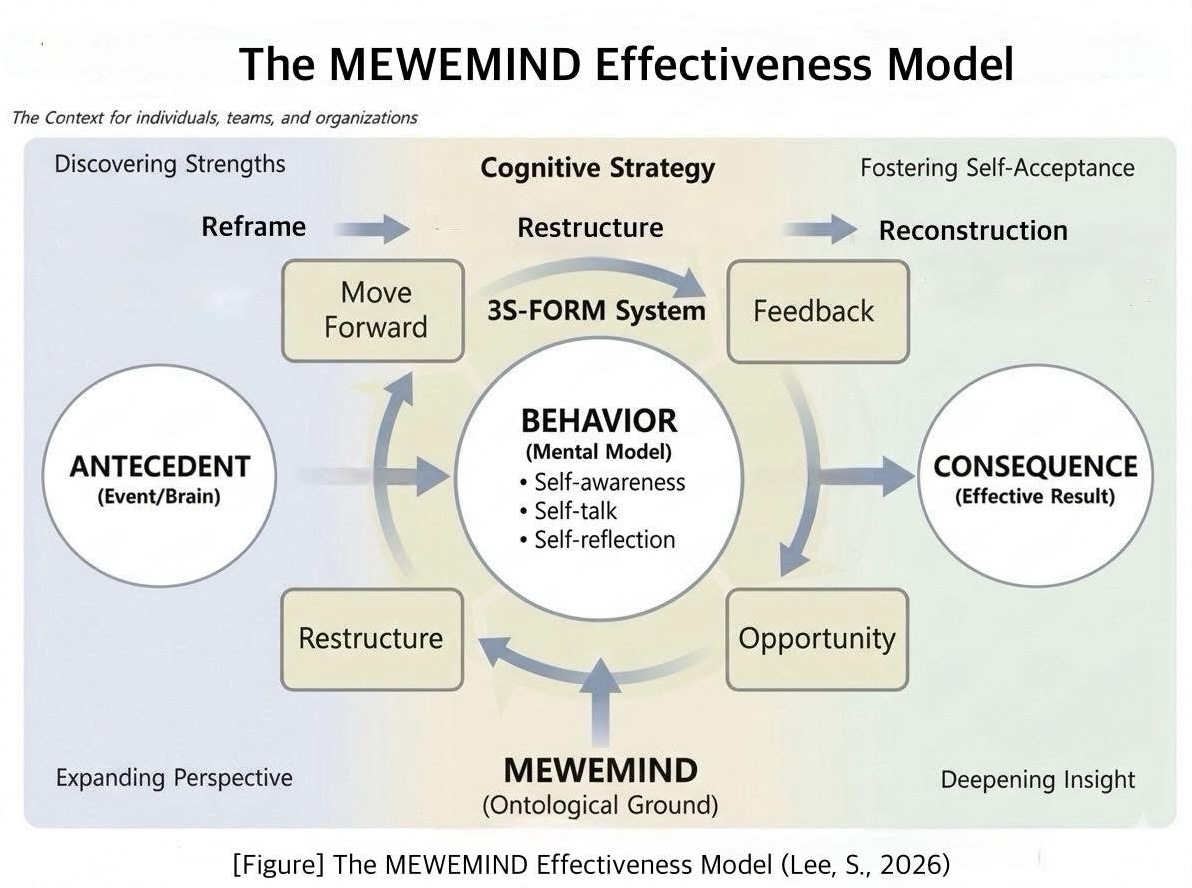
Step 1: Self-Awareness (3S Activation)
Ask:
- When does this thought recur?
- What emotional tone accompanies it?
- What situation triggered it?
The leader shifts from reaction to observation.
White bear becomes signal, not threat.
Step 2: Self-Talk Restructuring
Leaders often carry absolutist internal narratives:
- “I must always be decisive.”
- “If I show doubt, I lose authority.”
- “Conflict means loss of control.”
Restructure the internal script:
From:
Authority equals certainty.
To:
Authority includes containment of complexity.
Step 3: Self-Reflection
Examine relational meaning:
- Whose voice is this thought echoing?
- What unfinished conversation does it represent?
- What value is asking to be integrated?
This is where MEWEMIND becomes operational.
4. MEWEMIND in Leadership Practice
MEWEMIND proposes:
The leader (ME) is structurally embedded in the organization (WE).
Persistent rumination often reflects:
- Internalized stakeholder expectations
- Organizational culture pressure
- Unresolved relational friction
Instead of isolating ME from WE, the leader asks:
What aspect of WE is seeking integration within ME?
This reduces defensive leadership patterns.
5. FORM: Converting Insight into Execution
Insight must stabilize behaviorally.
1) Feedback
Use 360-degree data or trusted peer input to verify perception gaps.
2) Opportunity
Reframe recurring tension as developmental leverage.
For example:
Recurring thought:
“That senior manager challenges me constantly.”
Opportunity:
“This may be a signal to expand my influence strategy.”
3) Restructure
Redesign leadership mental models:
From:
Performance through control
To:
Performance through alignment
From:
Certainty creates trust
To:
Psychological safety creates trust
4) Move Forward
Translate restructuring into action:
- Initiate perspective-taking conversations
- Conduct relational alignment meetings
- Practice “lowering certainty by 20%”
- Explicitly invite dissent
Behavior stabilizes cognition.
6. Organizational Impact
Leaders who integrate rather than suppress:
- Reduce emotional leakage
- Improve perception alignment
- Increase psychological safety
- Enhance strategic adaptability
White bear suppression produces rigidity.
White bear integration produces maturity.
7. Executive Reflection Framework
When a thought persists, leaders can apply this sequence:
- Name it.
- Trace its relational origin.
- Redefine its meaning.
- Design one aligned behavioral experiment.
- Review impact after execution.
This creates a virtuous cycle:
Wandering → Awareness → Restructure → Execution → Effectiveness
8. Leadership Maturity Shift
At advanced stages of development, leaders no longer ask:
“How do I eliminate this thought?”
They ask:
“What is this tension teaching me about my relationship to the system?”
This shift marks movement from performance identity to systemic identity.
From isolated ME
to ME-within-WE.
Closing Insight
The leadership white bear is not an obstacle.
It is an invitation.
Suppression protects ego.
Integration strengthens influence.
In mature leadership:
- Doubt becomes data.
- Conflict becomes curriculum.
- Rumination becomes redesign.
And effectiveness deepens.
Reference
Lee, Sukjae (2020). How to Use a Wandering Mind. Seoul: Plan B Design.
Lee, Sukjae (2020). Coaching Methodology. Seoul: Korea Coaching Supervision.
Wegner, D. M. (1994). Ironic processes of mental control. Psychological Review, 101, 34-52.
Wegner, D. M. (1997). Why the mind wanders. In J. D. Cohen & J. W. Schooler (Eds.), Carnegie Mellon Symposium on Cognition. Scientific Approaches to Consciousness (p. 295-315). Lawrence Erlbaum Associates, Inc.


