

| 일 | 월 | 화 | 수 | 목 | 금 | 토 |
|---|---|---|---|---|---|---|
| 1 | 2 | 3 | 4 | 5 | 6 | 7 |
| 8 | 9 | 10 | 11 | 12 | 13 | 14 |
| 15 | 16 | 17 | 18 | 19 | 20 | 21 |
| 22 | 23 | 24 | 25 | 26 | 27 | 28 |
- 관점 코칭
- 코칭방법론
- 현장중심 코칭심리학
- Sukjae Lee Ph.D.
- 생각 파트너 이석재
- 경영심리학자의 효과성 코칭
- 효과성 코칭 방법론
- 효과성 프레임워크
- 증거기반코칭
- Effectiveness Coaching Model
- 효과성 코칭 모델
- 관점 전환
- 효과성 코칭
- Effectiveness Coaching
- 코치올
- 실행력을 높이는 코칭심리학 수업
- 현징증심 코칭심리학
- 이종서 코치
- 효과성코칭워크숍
- Effectiveness Coaching Methodology
- 코칭 프레임워크
- 떠도는 마음 사용법
- 3S-FORM Coaching Model
- 결정적 행동
- Coach Sukjae Lee
- 3S-FORM Coaching Model과 뇌과학의 결합
- thinking partner
- 코칭심리학 공부방
- 원하는 결과
- 씽킹 파트너
- Today
- Total
코치올
Integrating Mental Modeling Coaching with Shared Mental Models 본문
Integrating Mental Modeling Coaching with Shared Mental Models
생각파트너 이석재 2026. 1. 30. 12:19Integrating Mental Modeling Coaching with Shared Mental Models:
A 3S–FORM and Triple-Loop Learning Perspective
Sukjae Lee, Ph.D.
Creator of the Effectiveness Coaching Methodology
January 28, 2026
1. Positioning This Study in Existing Research
Research on shared mental models (SMMs) has consistently shown that team effectiveness depends not only on individual competence, but on the degree to which team members share aligned representations of tasks, roles, and performance logic (Cannon-Bowers, Salas, & Converse, 1993; Mohammed, Ferzandi, & Hamilton, 2010).
However, two limitations remain in much of the literature:
- Static focus – Shared mental models are often measured as states, not processes.
- Weak linkage to coaching practice – Few studies explain how shared mental models are intentionally reshaped through leadership or coaching interventions.
This article addresses these gaps by applying mental modeling coaching within the 3S–FORM architecture and interpreting the case through a triple-loop learning lens.
2. Mapping 3S–FORM to Shared Mental Model Restructuring (Team Level)
Below is a journal-ready conceptual mapping table that explicitly links:
- individual inner processes (3S),
- coaching interaction structure (FORM),
- and team-level shared mental model restructuring.
Table 1. 3S–FORM × Shared Mental Model Restructuring
| Level | Component | Function in Coaching | Contribution to Shared Mental Models | Related Research |
| Individual (Leader) | Self-Awareness | Recognizing implicit assumptions about performance and people | Leader identifies the existing dominant mental model guiding team interpretation | Argyris & Schön (1978): uncovering governing variables |
| Individual (Leader) | Self-Talk | Internal narrative shifts from blame to system logic | Leader reframes performance as a capability–outcome relationship | Mezirow (1991): meaning perspective transformation |
| Individual (Leader) | Self-Reflection | Evaluating impact of leadership assumptions | Leader validates new mental model through reflection | Schön (1983): reflection-in-action |
| Interaction (Coach–Leader) | Feedback | Making mental models explicit and discussable | Provides cognitive clarity and shared language | Cannon-Bowers et al. (1993): shared understanding |
| Interaction (Team Context) | Opportunity | Applying new framing in meetings and 1:1s | Repeated exposure aligns team interpretation | Weick (1995): sensemaking through enactment |
| Interaction (Team Context) | Restructure | Rebuilding performance logic collectively | Old shared assumptions replaced by new collective schema | Fiol & O’Connor (2017): collective cognition change |
| Action (Team) | Move Forward | Consistent leadership behaviors reinforce model | New shared mental model stabilizes in routines | Senge (1990): shared vision & learning |
| Team (Collective) | Shared Mental Model | Common performance logic emerges | Team coordinates action with less friction | Mohammed et al. (2010): team cognition & performance |
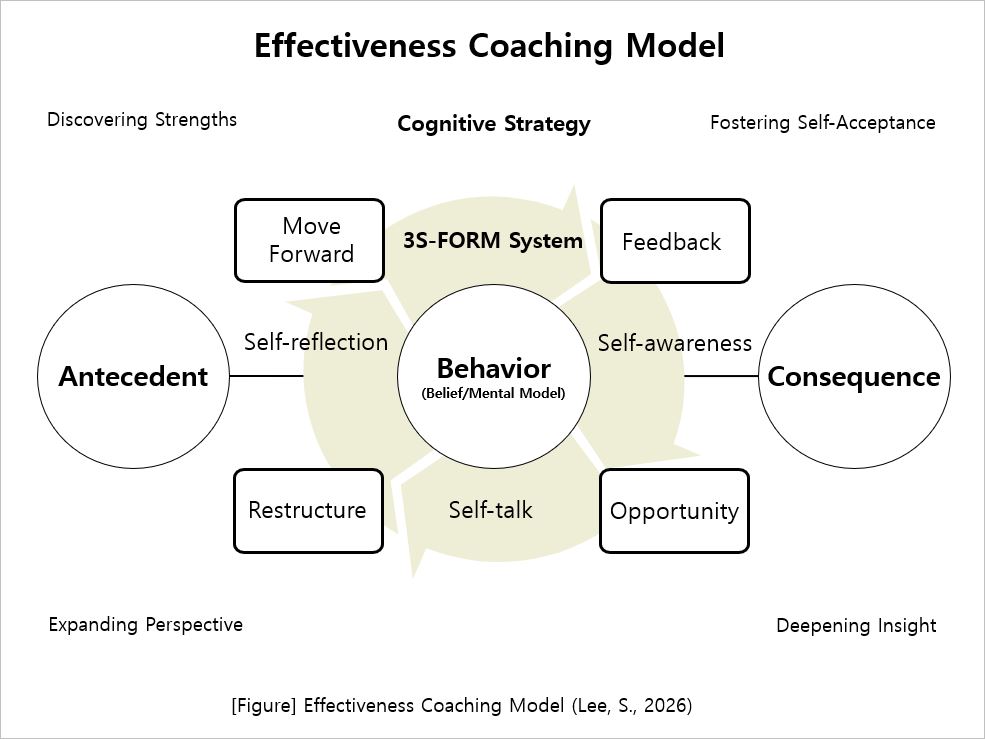
Key Contribution
This table demonstrates that 3S–FORM is not merely a coaching conversation flow, but a mental model transmission architecture—connecting inner cognitive shifts to team-level shared meaning systems.
3. Triple-Loop Learning Interpretation
3.1 Single-Loop Learning: Behavioral Adjustment
What changed?
- Team meetings improved.
- One-on-one conversations became more focused.
- Training became more targeted.
Argyris (1977) – correcting errors without altering underlying assumptions.
3.2 Double-Loop Learning: Mental Model Restructuring
What assumptions changed?
- Performance ≠ effort alone.
- Development ≠ generic training.
- Leadership ≠ uniform treatment.
The Performance–Capability Matrix enabled the team to question why performance differed and how capability should be developed.
:
Argyris & Schön (1978) – questioning governing variables.
3.3 Triple-Loop Learning: Reconstructing “How We Think Together”
At the team level, the most significant change was not behavioral or cognitive alone, but ontological:
“Performance discussions are not evaluations—we use them to think together.”
This reflects triple-loop learning, where teams reconfigure:
- how learning itself occurs,
- how meaning is co-created,
- and what leadership is for.
Bateson (1972): Learning III
Tosey, Visser, & Saunders (2012): levels of learning clarified
Nicolini (2012): practice-based knowing
4. Shared Mental Models as the Missing Link in Coaching Effectiveness
Many coaching outcome studies focus on:
- coachee satisfaction,
- leader behavior change,
- or short-term performance indicators.
This case suggests a deeper mechanism:
Coaching becomes scalable and sustainable when it restructures shared mental models.
This aligns with OD research emphasizing that:
- culture is embedded in everyday sensemaking (Weick, 1995),
- and leadership is enacted through repeated interpretive acts (Smircich & Morgan, 1982).
5. Implications for HR / OD Research and Practice
5.1 For Research
- Move beyond individual-level coaching outcomes.
- Measure shared mental model alignment longitudinally.
- Explore mental modeling coaching as a bridge between coaching and OD.
5.2 For Practice
- Equip leaders with mental model carriers (e.g., matrices, frameworks).
- Design coaching programs that explicitly target team cognition, not only behavior.
- Evaluate coaching impact at interaction pattern and sensemaking levels.
References
- Argyris, C. (1977). Double loop learning in organizations. Harvard Business Review.
- Argyris, C., & Schön, D. A. (1978). Organizational learning. Addison-Wesley.
- Bateson, G. (1972). Steps to an ecology of mind. Chandler.
- Cannon-Bowers, J. A., Salas, E., & Converse, S. (1993). Shared mental models in expert team decision making. Individual and Team Decision Making.
- Fiol, C. M., & O’Connor, E. J. (2017). Unlearning established organizational routines. Organization Science.
- Mezirow, J. (1991). Transformative dimensions of adult learning. Jossey-Bass.
- Mohammed, S., Ferzandi, L., & Hamilton, K. (2010). Metaphor no more: A 15-year review of shared mental model research. Journal of Management.
- Nicolini, D. (2012). Practice theory, work, and organization. Oxford University Press.
- Schön, D. A. (1983). The reflective practitioner. Basic Books.
- Senge, P. M. (1990). The fifth discipline. Doubleday.
- Smircich, L., & Morgan, G. (1982). Leadership as the management of meaning. Journal of Applied Behavioral Science.
- Tosey, P., Visser, M., & Saunders, M. (2012). The origins and conceptualizations of ‘triple-loop’ learning. Management Learning.
- Weick, K. E. (1995). Sensemaking in organizations. Sage.
'3. 코칭심리연구 > 코칭심리 탐구' 카테고리의 다른 글
| 멘탈 모델링: 지속하는 변화 알고리즘 (0) | 2026.01.31 |
|---|---|
| From Coaching Intervention to Organizational Capability: Reframing Performance Leadership through an HR/OD Lens (0) | 2026.01.30 |
| 멘탈 모델링 코칭이 갖는 의미 (0) | 2026.01.30 |
| Restructuring Executive Mental Models as a Lever for Collective Effectiveness (0) | 2026.01.28 |
| Mental Modeling Coaching: Becoming the Architect of Life Change (0) | 2026.01.26 |


