
| 일 | 월 | 화 | 수 | 목 | 금 | 토 |
|---|---|---|---|---|---|---|
| 1 | 2 | 3 | 4 | 5 | 6 | 7 |
| 8 | 9 | 10 | 11 | 12 | 13 | 14 |
| 15 | 16 | 17 | 18 | 19 | 20 | 21 |
| 22 | 23 | 24 | 25 | 26 | 27 | 28 |
- Effectiveness Coaching
- Effectiveness Coaching Model
- 이종서 코치
- 코칭방법론
- 실행력을 높이는 코칭심리학 수업
- 효과성 코칭 방법론
- 증거기반코칭
- 코칭심리학 공부방
- 효과성코칭워크숍
- 떠도는 마음 사용법
- 효과성 코칭 모델
- 관점 전환
- 효과성 프레임워크
- Coach Sukjae Lee
- 효과성 코칭
- 코칭 프레임워크
- 관점 코칭
- 현장중심 코칭심리학
- 결정적 행동
- 3S-FORM Coaching Model
- 3S-FORM Coaching Model과 뇌과학의 결합
- 경영심리학자의 효과성 코칭
- 코치올
- Effectiveness Coaching Methodology
- 효과적 리더십진단(ELA)
- 씽킹 파트너
- thinking partner
- 현징증심 코칭심리학
- 생각 파트너 이석재
- 원하는 결과
- Today
- Total
코치올
Coaching Methodology 본문
Coaching Methodology
Sukjae Lee, Ph.D.
Creator of the Effectiveness Coaching Methodology
February 13, 2026
Developing My Answer to the Question: What Is Coaching?
Now in my twenty-fourth year as a professional coach, I continue to refine my own answer to the question: What is coaching?
The answer I have arrived at so far can be summarized in one phrase: Effectiveness Coaching.
Effectiveness refers to the degree to which desired results are achieved. Effectiveness Coaching is a goal-oriented, collaborative process that increases the likelihood that individuals and organizations will obtain the results they seek.
This definition immediately raises further questions:
- What factors influence the likelihood of achieving desired results?
- How should collaborative activities be structured to increase that likelihood?
- How can a series of activities designed to improve effectiveness be expressed in a coherent logical model?
- How should coaching based on the Effectiveness Coaching Model be designed and validated?
- What diagnostic tools and evaluation methods are appropriate?
As answers to these questions emerged, deeper inquiries followed.
The Effectiveness Coaching Program Receives International Accreditation
Through repeatedly applying Effectiveness Coaching in corporate settings and continually refining it in response to emerging research questions, I developed the Effectiveness Coaching Model, the Effectiveness Diagnostic tools, and a comprehensive coaching methodology.
In 2014, I introduced the Effectiveness Coaching Methodology for the first time through the publication of Effectiveness Coaching by a Management Psychologist. Beginning in January 2015, I launched the Effectiveness Coaching Workshop: Individual Coaching and Organizational Coaching as a structured learning program.
In July 2018, this workshop received accreditation from the International Coaching Federation (ICF) as a Continuing Coach Education (CCE) program, approved for 30 hours toward the ongoing development of professional coaches.
Having previously obtained the global credential of Professional Certified Coach (PCC) in 2008, I experienced renewed confidence in the validity and rigor of the Effectiveness Coaching program through this formal recognition. This validation strengthened my commitment to applying and expanding Effectiveness Coaching in real organizational contexts.
This Is the Era of Coaching Methodology
Since the first evidence-based coaching research symposium was held at the University of Sydney in 2003, evidence-based coaching has become a global trend within the coaching industry (Grant, 2016).
In the early developmental stage of coaching, individual beliefs, accumulated experience, and perceived expertise played decisive roles in clients’ decisions to select coaching services. More recently, coaching approaches grounded in behavioral science and adult learning theory—and supported by field research—have gained recognition as credible, evidence-based decision criteria at a global level.
Coaching is not merely a problem-solving intervention. Rather, it unfolds as a personalized developmental process that helps individuals maximize their potential in order to achieve desired outcomes in life and work.
The theoretical foundations of coaching have also diversified. What once centered around single theoretical orientations has evolved toward integrative models that synthesize multiple theoretical streams (Stober & Grant, 2006).
It is true that “evidence” often refers to validated research findings. However, validated research represents only one form of evidence. Questions remain regarding whether universally accepted criteria for evidence-based coaching have been firmly established. Some critics argue that evidence-based coaching selectively gathers theoretical support to legitimize preexisting approaches.
Nevertheless, given coaching’s relatively short history and its ongoing evolution as an independent professional domain, there is now broad support for the idea that coaching approaches must be subject to validation.
For coaching approaches to be validated, coaching methodology is required.
Coaching methodology does not prescribe answers or solutions to coaching issues. Rather, it provides a logical framework that guides coaches in selecting and applying appropriate methods.
In exploring Effectiveness Coaching, I developed a logical structure that strengthens the connection between:
- Change Demand
- Critical Behavior
- Desired Results
This structure evolved into the Effectiveness Coaching Model.
To examine the relationships among these three factors within individual, team, and organizational contexts, I apply quasi-experimental coaching designs and utilize Effectiveness Diagnostic tools to identify leverage points for change, clarify coaching goals, and evaluate outcomes.
In Korea, systematic field research grounded in coaching methodology remains limited. For coaching to continue growing as an industry and to establish itself as an academic discipline, methodological foundations—not theory alone—must guide practice.
I have been applying the Effectiveness Coaching Methodology in corporate coaching and, although my experience remains evolving, I offer it here for broader consideration. I believe that coaching conducted in corporate environments must now be framed within a methodological structure.
Upgrading the Effectiveness Coaching Methodology
Although the Effectiveness Coaching Workshop introduced the methodology through case studies and practice exercises, I felt the need to share the entire coaching process—from initiation to closure—in greater detail.
Initially, I planned a revised and expanded edition of my earlier book. However, as the scope of revision expanded, I ultimately decided to publish a new book centered on the structure of the internationally accredited Effectiveness Coaching Workshop.
In the process of writing, I experienced profound fulfillment in articulating my evolving answer to the question: What is coaching?
I revised the original Strength-Based Effectiveness Model (Lee, 2014) and integrated it with the psychological mechanisms underlying Effectiveness Coaching, thereby developing the refined Effectiveness Coaching Model. I rewrote the key conceptual components for clarity and accessibility.
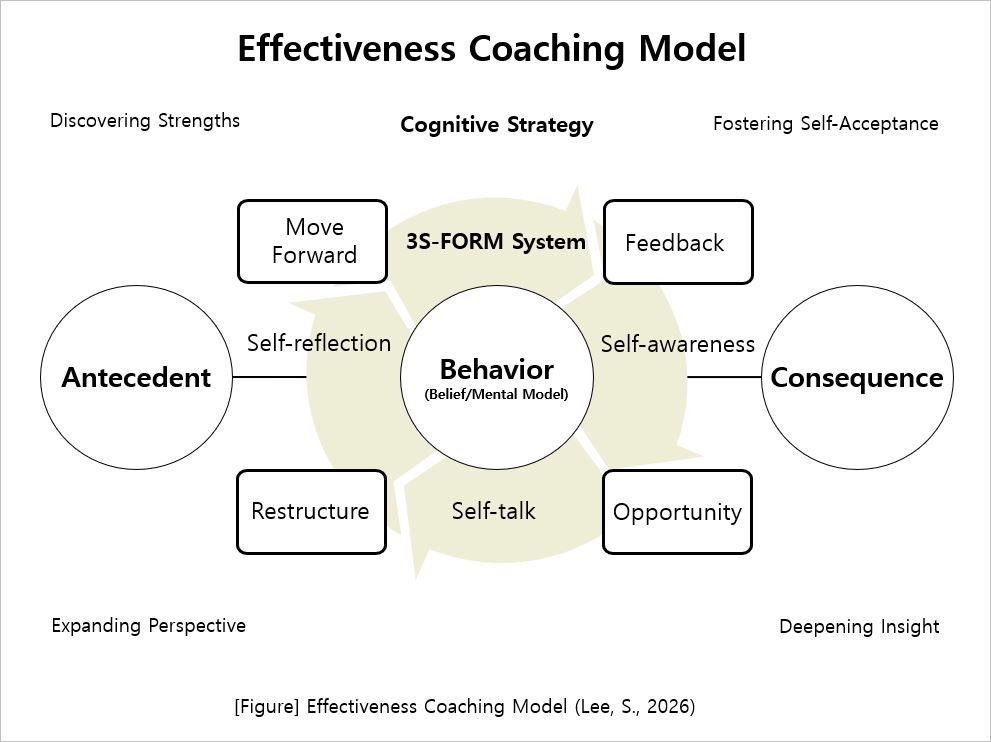
I also presented the foundational architecture of integrative coaching design and introduced methods for quasi-experimental coaching design, recognizing both the demand for evidence-based coaching and the realities of field application.
In addition, I incorporated coaching cases from the past five years conducted under the Effectiveness Coaching Model and integrative design framework, and I elaborated on evaluation methods in greater detail.
All case descriptions are real. To protect confidentiality, names and job titles have been altered, and organizations are presented anonymously or under pseudonyms.
Anticipating Field Application and Expansion
This book is a practical guide for applying the Effectiveness Coaching Methodology in corporate settings. It is structured in two parts.
Part I: The Integrative Approach to Effectiveness Coaching
Chapter 1 introduces the concept of Effectiveness Coaching and its core components:
- Change Demand
- Critical Behavior
- Desired Results
It further presents three forms of alignment for enhancing organizational effectiveness and discusses productivity and positivity as two dimensions leaders must manage. Coaching leadership enhances productivity through positivity. Positivity and productivity form the central axes of team and organizational effectiveness and provide the conceptual framework for effectiveness diagnostics.
Effectiveness Coaching is a collaborative process that produces desired results explicitly defined in mutually agreed coaching goals.
The foundational 3S-FORM change model is introduced in detail, explaining its conceptual structure and operational mechanisms.
Chapter 2 explains the basic framework and methods for integrative coaching design, including quasi-experimental design approaches for field application.
Part II: The Execution of Effectiveness Coaching
Part II addresses the full lifecycle of coaching activities in corporate contexts—from initiation to evaluation.
Chapter 3 explains how to construct and interpret the “Effectiveness Weather Map,” a tool derived from diagnostic results to identify interconnected patterns among individual, team, and organizational effectiveness.
Chapter 4 presents methods and examples for setting coaching goals.
Chapters 5 through 7 introduce coaching design, skills, and case examples for facilitating:
- Individual change
- Team change
- Organizational change
Readers may focus on chapters aligned with their interests and learn practical methods for applying Effectiveness Coaching in the field.
Chapter 8 presents the evaluation model for Effectiveness Coaching, including:
- Evaluation guidelines
- Midpoint progress checks
- Final outcome evaluation
It also addresses the necessity of consulting-oriented recommendations, ROI analysis, and research agendas for performance evaluation.
Intended Audience
This book is intended to support:
- Professional coaches
- Internal corporate coaches
- Organizational leaders who coach their team members
- Talent development professionals
- Counselors, corporate trainers, and consultants
- Aspiring coaches
- Scholars and graduate students researching evidence-based coaching
- Professionals seeking to develop their own coaching methodology
As a professional coach working in corporate settings, I continue to integrate coaching theory and practice. This book represents the fourth milestone in that journey.
It is not a conclusion, but the fourth knot tied along the way.
I will continue conducting empirical field research to strengthen and expand the conceptual and methodological foundations of Effectiveness Coaching.
May this book broaden your perspective on coaching and contribute to the expansion of coaching practice in ways that meaningfully serve society.
Table of Contents
Prologue
Part I: The Integrative Approach to Effectiveness Coaching
What Is Effectiveness Coaching?
Coaching Based on the Effectiveness Coaching Model
Enhancing Productivity Through Positivity
Identifying Change Points Through Diagnosis and Feedback
Creating Change Through Collaborative Coaching
Integrative Coaching Design
Considerations in Coaching Design
Integrated Design for Individual, Team, and Organization
Quasi-Experimental Coaching Design Methods
Part II: The Execution of Effectiveness Coaching
Effectiveness Diagnosis and Feedback
- Effectiveness Diagnosis
- Effectiveness Weather Map Analysis
- Feedback Methods
Setting Change Goals
- Why Goals Fail
- Behavior-Centered Change Planning
- Writing a Coaching Goal Statement
Coaching for Individual Change
- Creating Change Through Critical Behavior
- Addressing Execution Before “Being”
- Five Questions That Awaken Self-Awareness
- Strengthening Behavioral Change
- Case 1: Executive Leadership Coaching
- Case 2: Increasing Communication Effectiveness Through Work Alignment
- Case 3: Managing Resistance to Change
Coaching for Team Change
- Facilitating Team Change Through Workshops
- Diagnostic-Based Customized Team Coaching
- Building the Team Emotional Bank Account
- Driving Rapid and Dramatic Change
- Case 1: Team Effectiveness Improvement Workshop
- Case 2: Creating a Positive Team Culture
- Case 3: Activating the Team Through Mutual Understanding
Coaching for Organizational Change
- Building Foundations for Organizational Effectiveness
- Enhancing Employee Engagement
- Eliminating Defensive Routines
- Sharing Inner Perspectives
- Case 1: Organizational Effectiveness Workshop
- Case 2: Strengthening Presence to Build Organizational Identity
- Case 3: Linking Individual, Team, and Organizational Change
Evaluation of Effectiveness Coaching
- Evaluation Model
- Performance Evaluation Guidelines
- Midpoint Checkpoints
- Final Outcome Evaluation
- Consulting Recommendations
- Research Agenda for Performance Evaluation
Epilogue
References
Source: Lee, Sukjae (2019). Coaching Methodology. Seoul: Korea Coaching Supervision Academy.
'3. 코칭심리연구 > 코칭심리 탐구' 카테고리의 다른 글
| Revisiting the Effectiveness Coaching Methodology (0) | 2026.02.13 |
|---|---|
| Field-Focused Coaching Psychology in Dialogue with the 3S–FORM System and the Effectiveness Coaching Methodology (0) | 2026.02.13 |
| Field-Focused Coaching Psychology (0) | 2026.02.13 |
| 결과지향 코칭 프레임워크 (0) | 2026.02.13 |
| ME를 뒤집으면 WE가 된다 (0) | 2026.02.12 |


