

| 일 | 월 | 화 | 수 | 목 | 금 | 토 |
|---|---|---|---|---|---|---|
| 1 | 2 | 3 | ||||
| 4 | 5 | 6 | 7 | 8 | 9 | 10 |
| 11 | 12 | 13 | 14 | 15 | 16 | 17 |
| 18 | 19 | 20 | 21 | 22 | 23 | 24 |
| 25 | 26 | 27 | 28 | 29 | 30 | 31 |
- 떠도는 마음 사용법
- 효과성 코칭
- 원하는 결과
- 코치올
- 코칭방법론
- 현징증심 코칭심리학
- 이종서 코치
- 코칭심리학 공부방
- 실행력을 높이는 코칭심리학 수업
- 코칭심리학
- Effectiveness Coaching Model
- 관점 코칭
- 씽킹 파트너
- thinking partner
- 효과성 코칭 방법론
- 결정적 행동
- 현장중심 코칭심리학
- 경영심리학자의 효과성 코칭
- 3S-FORM Coaching Model
- 효과성 코칭 모델
- Effectiveness Coaching
- 효과성코칭워크숍
- 효과성 프레임워크
- 관점 전환
- 코칭 프레임워크
- 생각 파트너 이석재
- Effectiveness Coaching Methodology
- Coach Sukjae Lee
- 증거기반코칭
- 3S-FORM Coaching Model과 뇌과학의 결합
- Today
- Total
코치올
From Perspective Change to Meaning-Level Transformation 본문
From Perspective Change to Meaning-Level Transformation
생각파트너 이석재 2025. 12. 14. 16:25From Perspective Change to Meaning-Level Transformation:
The 3S–FORM Framework for Sustainable Effectiveness in Coaching
Sukjae Lee, Ph.D.
Creator of the Effectiveness Coaching Methodology
December 14, 2025
Citation
Abstract
Despite the widespread emphasis on perspective change in coaching and adult development, perspective-focused interventions frequently produce only temporary behavioral shifts. This paper argues that such limitations stem from a structural misunderstanding of the relationship between perspective, belief, and mental models. Drawing on the Effectiveness Coaching Methodology developed by Dr. Lee Suk-Jae, the paper introduces the 3S–FORM framework as an integrated model for sustainable behavioral and effectiveness outcomes.
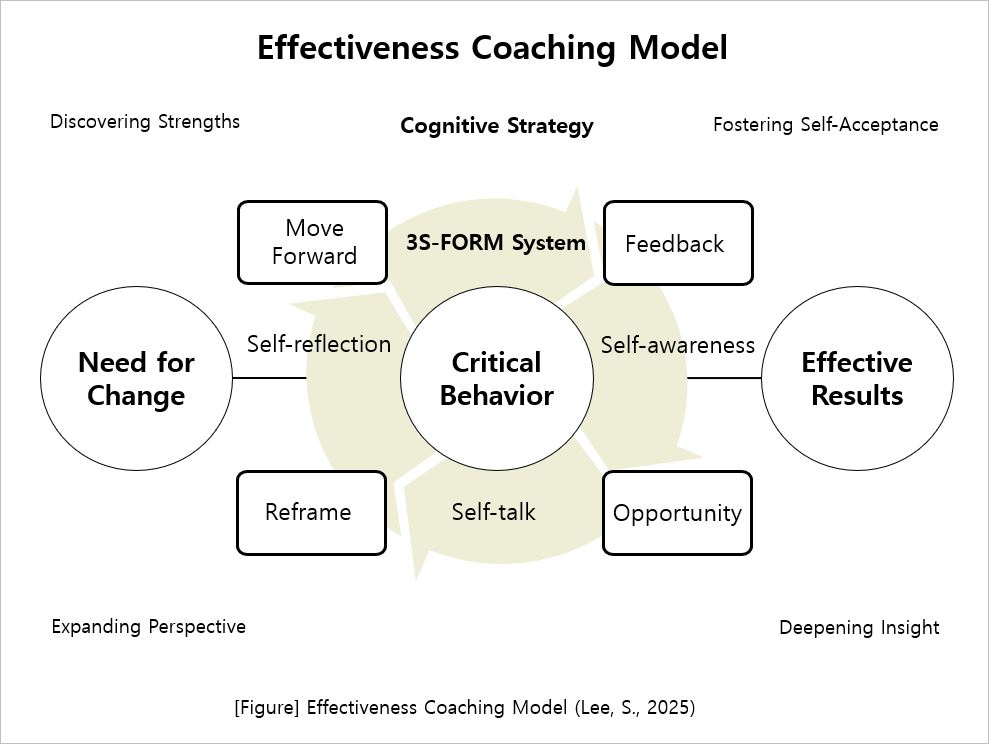
Within this framework, mental models are conceptualized as underlying meaning structures that generate beliefs, assumptions, and situational perspectives, while perspectives are treated as contextual expressions rather than primary drivers of behavior. The 3S model (Self-Awareness, Self-Talk, Self-Reflection) is proposed as the client’s Inner Growth Engine, enabling meaning-level reorganization through reflective inquiry. Complementing this internal process, FORM (Feedback, Opportunity, Reframe, Move Forward) provides an external facilitation structure through which coaches support transformation without imposing cognitive solutions.
Using illustrative coaching cases, the paper demonstrates that perspective change emerges as a byproduct of mental model reorganization, resulting in durable behavioral change. The study contributes to coaching theory by offering a structurally differentiated account of belief, perspective, and mental model dynamics, and by positioning effectiveness as the central criterion for sustainable change.
Keywords
Effectiveness Coaching Methodology; 3S–FORM Model; Mental Models; Perspective; Beliefs and Assumptions; Meaning-Making; Sustainable Behavior Change; Coaching Theory; Adult Development
1. Introduction
1.1 Background
Perspective change has long occupied a central position in coaching and adult development literature. Approaches grounded in cognitive-behavioral coaching, constructivist learning theory, and transformational learning commonly emphasize reframing interpretations, challenging limiting beliefs, and adopting alternative viewpoints as mechanisms for change. Such interventions are widely regarded as effective means of influencing emotion, motivation, and behavior.
However, practitioners frequently report a recurring phenomenon: while perspective change can generate insight and short-term behavioral adjustment, these changes often fail to persist under pressure or across contexts. Clients may intellectually endorse new perspectives yet revert to previous patterns when confronted with familiar demands. This discrepancy suggests that perspective change alone may be insufficient to explain sustainable development.
1.2 Problem Statement
The persistence of this problem points to a deeper conceptual issue. In much of the coaching literature, perspective, belief, and mental models are not clearly differentiated, and are often used interchangeably. As a result, interventions tend to focus on modifying surface-level cognition without adequately addressing the deeper meaning-making systems that generate it.
This lack of structural clarity obscures the mechanisms through which sustainable change occurs and limits the explanatory power of existing coaching models. Consequently, there is a need for a framework that explicitly accounts for how perspectives are generated, maintained, and transformed.
1.3 Purpose of the Paper
The purpose of this conceptual paper is threefold. First, it seeks to clarify the structural relationship among mental models, beliefs, and perspectives. Second, it introduces the 3S–FORM framework, developed within the Effectiveness Coaching Methodology by Dr. Lee Suk-Jae (Lee, S., 2014; 2023), as a model for meaning-level transformation. Third, it articulates why sustainable effectiveness emerges not from direct perspective modification, but from the reorganization of the mental models that generate perspective.
1.4 Research Questions
This paper addresses the following conceptual questions:
- Why does perspective change often fail to produce sustainable behavioral outcomes?
- What role do mental models play in shaping beliefs and perspectives?
- How does the 3S–FORM framework operationalize meaning-level change in coaching practice?
2. Literature Review
2.1 Perspective in Coaching and Adult Development
Perspective has been widely conceptualized as a driver of development, particularly within transformational learning theory (Mezirow, 1991) and constructivist approaches to adult learning. These models emphasize critical reflection on assumptions as a pathway to perspective transformation. Similarly, cognitive-behavioral coaching frameworks focus on reframing maladaptive interpretations to influence emotional and behavioral responses.
While these approaches have demonstrated utility, they tend to position perspective as the primary causal mechanism. Less attention is given to the deeper meaning structures that constrain which perspectives are cognitively and emotionally available to an individual.
2.2 Beliefs and Assumptions as Intervention Targets
Beliefs—especially so-called “limiting beliefs”—are frequently treated as discrete targets of coaching intervention. Clients are encouraged to identify and replace beliefs that inhibit performance or well-being. However, when beliefs are addressed in isolation, interventions risk becoming prescriptive, leading to intellectual compliance rather than structural change.
This limitation suggests that beliefs may function less as independent variables and more as components of broader meaning systems.
2.3 Mental Models in Organizational Theory
Mental models have been extensively discussed in organizational learning literature (Argyris & Schön, 1978; Senge, 1990) as deeply held assumptions that influence perception and action. Despite their theoretical relevance, mental models have not been sufficiently operationalized within individual coaching contexts, leaving a gap between theory and practice.
2.4 Identified Gap
The literature reveals a lack of integrative coaching frameworks that (a) structurally differentiate perspective, belief, and mental model, and (b) explain how sustainable change occurs at the level of meaning-making. The 3S–FORM framework is proposed as a response to this gap.
3. Conceptual Framework
3.1 Core Constructs
Mental models are defined as relatively stable, pre-conscious systems of meaning that organize interpretation, judgment, and action. They consist of interrelated premises, assumptions, beliefs, and causal logics.
Beliefs and assumptions are articulated components of mental models. While they can be verbalized, their coherence derives from the broader structure in which they are embedded.
Perspective is conceptualized as the situational expression of a mental model—how meaning is instantiated in a particular context.
3.2 Structural Relationship
The generative relationship among these constructs can be represented as:
Mental Model → Beliefs & Assumptions → Perspective → Interpretation & Judgment → Behavior → Effectiveness Outcomes
Within this hierarchy, perspective is not causal but expressive. It reflects how a mental model is currently operating rather than independently determining behavior.
4. The 3S–FORM Framework
4.1 Overview
The 3S–FORM framework is a dual-system model comprising an internal meaning-reorganization process (3S) and an external facilitation structure (FORM). Together, these systems address both the generative and contextual dimensions of change (Lee, S., & Lee, J., 2025).
4.2 3S: The Inner Growth Engine
Self-Awareness involves non-evaluative observation of one’s current thoughts, emotions, and reactions. Perspectives are treated as data rather than errors to be corrected.
Self-Talk refers to the examination of internal dialogue, enabling beliefs and assumptions to be articulated and explored without immediate replacement.
Self-Reflection introduces effectiveness as the evaluative criterion, allowing individuals to assess whether existing mental models continue to serve their goals and contexts.
Through repeated cycles of 3S, mental models are reorganized rather than overridden.
4.3 FORM: External Facilitation Structure
Feedback grounds reflection in observable reality.
Opportunity reframes challenges as learning contexts.
Reframe emerges as an indicator of internal restructuring rather than a coaching technique.
Move Forward consolidates change through action and experimentation.
5. Illustrative Coaching Cases
5.1 Methodological Note
The cases presented in this section are illustrative rather than empirical. Their purpose is not to provide statistical generalization, but to clarify how the proposed conceptual framework operates in practice. Such use of illustrative cases is consistent with prior conceptual work in coaching and organizational development, where examples serve to explicate theoretical mechanisms rather than test hypotheses.
All cases are anonymized composites derived from recurring coaching patterns observed across multiple engagements. They are selected specifically to demonstrate how perspective change emerges as a consequence of mental model reorganization rather than as a direct intervention target.
5.2 Case 1: Difficulty Speaking Up in Meetings
The first case involves a senior professional who reports difficulty speaking up during meetings despite recognizing the importance of participation. The presenting issue is framed as a confidence or communication problem, and the client initially attempts to adopt alternative perspectives, such as viewing meetings as safe or low-risk environments.
Through the 3S process, the client develops awareness of a recurring internal response characterized by tension and self-monitoring. Examination of self-talk reveals an underlying assumption: that competent professionals should avoid visible mistakes. Reflection on this assumption highlights its historical effectiveness earlier in the client’s career, while also revealing its current limitations in collaborative and knowledge-based contexts.
As this mental model shifts—from performance protection to shared contribution—the client’s perspective on meetings changes organically. Speaking up is no longer experienced as a risk to competence, but as an integral part of collective thinking. Behavioral change follows without deliberate confidence-building techniques.
5.3 Case 2: Leadership and Perceived Resistance
The second case concerns a manager who interprets team pushback as resistance and lack of trust. The presenting perspective positions disagreement as a threat to authority, leading to frustration and defensiveness.
Through Self-Awareness, the manager recognizes emotional reactivity when proposals are questioned. Self-Talk surfaces an implicit belief that effective leadership requires compliance. Self-Reflection reveals that while this model may be effective in crisis situations, it is counterproductive in complex, adaptive environments.
As the mental model reorganizes toward a sense-making orientation, resistance is reinterpreted as engagement and informational input. Importantly, this reframing is not imposed by the coach, but emerges from the manager’s reassessment of effectiveness. The manager’s behavior shifts toward inquiry and co-construction, resulting in improved team dynamics.
5.4 Case 3: Chronic Overworking
The third case involves a high-performing individual who reports persistent overworking despite diminishing returns. The client initially frames the issue as a lack of discipline around boundaries.
Through the 3S process, anxiety associated with slowing down becomes a focal point of awareness. Examination of self-talk reveals a mental model equating value with effort and constant exertion. Reflection highlights that this model previously supported achievement, but now undermines judgment, sustainability, and overall effectiveness.
As the mental model shifts toward an effectiveness-based valuation of work, rest and focus are reinterpreted as strategic rather than indulgent. Behavioral change occurs without reliance on willpower or external enforcement.
5.5 Cross-Case Analysis
Across all three cases, several consistent patterns emerge. First, perspective change is never the starting point of intervention. Instead, it functions as a visible indicator that deeper meaning reorganization has occurred. Second, behavioral change follows mental model shifts without coercion or prescriptive instruction. Third, effectiveness—rather than correctness or positivity—serves as the primary evaluative criterion guiding transformation.
These patterns support the central claim of the paper: sustainable change is generated at the level of meaning-making, not perspective adjustment.
6. Discussion
6.1 Theoretical Contributions
This paper makes three primary contributions to coaching theory. First, it offers a structural differentiation among mental models, beliefs, and perspectives, addressing a long-standing conceptual ambiguity in the literature. Second, it reframes perspective change as an outcome rather than a causal mechanism, thereby resolving inconsistencies between theory and observed coaching practice. Third, it introduces the 3S–FORM framework as a systematic model for operationalizing meaning-level change.
By positioning mental models as generative structures rather than abstract constructs, the framework advances existing theories of adult development and organizational learning.
6.2 Implications for Coaching Practice
Practically, the 3S–FORM framework suggests a shift in the coach’s role—from problem-solver or cognitive corrector to facilitator of internal growth processes. Coaches are encouraged to resist premature reframing and instead support clients in examining how their current perspectives are generated and sustained.
This shift has ethical implications as well, as it reduces the risk of imposing normative interpretations and preserves client agency in the change process.
6.3 Relationship to Existing Theories
The framework aligns with constructivist and transformational learning traditions in its emphasis on meaning-making. However, it differs in three important respects. First, it explicitly operationalizes mental model transformation within coaching sessions. Second, it introduces effectiveness as the primary evaluative standard, rather than insight or awareness alone. Third, it provides a dual-system structure that clarifies the distinct yet complementary roles of client and coach.
7. Limitations and Future Research
As a conceptual paper, the present study does not provide empirical validation of the 3S–FORM framework. Future research should explore longitudinal outcomes associated with meaning-level interventions, develop reliable measures for the 3S processes, and examine comparative effectiveness across coaching modalities.
Additionally, empirical investigation is needed to assess how mental model transformation interacts with contextual variables such as organizational culture and leadership role.
8. Conclusion
This paper argues that the persistent limitations of perspective-focused coaching stem from a misunderstanding of how change is generated. Perspectives do not drive behavior directly; they express the mental models that do. Sustainable effectiveness, therefore, requires intervention at the level of meaning-making.
The 3S–FORM framework provides a structured pathway for such intervention, integrating internal growth processes with external facilitation. By repositioning effectiveness as the central criterion of change, the framework offers both theoretical clarity and practical relevance for the coaching field.
References
Argyris, C., & Schön, D. A. (1978). Organizational learning: A theory of action perspective. Addison-Wesley.
Lee, Sukjae (2014). Management Psychologist's Effectiveness Coaching. Seoul: Kim & Kim Books.
Lee, Sukjae (2023). Field-Focused Coaching Psychology. Seoul: Hakjisa.
Lee, Sukjae & Lee, Jongseo (2025). Perspective Shifting. Seoul: Parkyoungstory.
Mezirow, J. (1991). Transformative dimensions of adult learning. Jossey-Bass.
Senge, P. M. (1990). The fifth discipline: The art and practice of the learning organization. Doubleday.
Stober, D. R., & Grant, A. M. (2006). Evidence based coaching handbook. Wiley.
Grant, A. M. (2012). Making positive change: A randomized study comparing solution-focused vs. problem-focused coaching. Journal of Systemic Therapies, 31(2), 21–35.
 |
 |
 |
 |
'3. 코칭심리연구 > 코칭심리 탐구' 카테고리의 다른 글
| 2026년을 위한 선택 (0) | 2025.12.18 |
|---|---|
| 멘탈모델 집중 탐구 (0) | 2025.12.16 |
| 관점과 신념은 어떻게 다른가? (1) | 2025.12.14 |
| 관전 전환 후속편 (0) | 2025.12.12 |
| 효과성 코칭과 효과적인 코칭의 차이점 (0) | 2025.12.12 |


