
| 일 | 월 | 화 | 수 | 목 | 금 | 토 |
|---|---|---|---|---|---|---|
| 1 | 2 | 3 | 4 | 5 | 6 | |
| 7 | 8 | 9 | 10 | 11 | 12 | 13 |
| 14 | 15 | 16 | 17 | 18 | 19 | 20 |
| 21 | 22 | 23 | 24 | 25 | 26 | 27 |
| 28 | 29 | 30 | 31 |
- 코칭심리학 공부방
- 코칭심리학
- 코칭방법론
- 이석재 코치
- 생각 파트너 이석재
- 코칭 프레임워크
- 실행력을 높이는 코칭심리학 수업
- 씽킹 파트너
- 코치올
- 효과성 코칭 방법론
- 떠도는 마음 사용법
- 효과성 코칭의 이론과 실제
- 관점 코칭
- 효과성 코칭 워크숍
- 효과성코칭
- 효과성코칭워크숍
- 결정적 행동
- 코칭심리학 시리즈
- 효과성 코칭
- 효과적 리더십진단(ELA)
- 원하는 결과
- 현장중심 코칭심리학
- 효과성 코칭 모델
- Coach Sukjae Lee
- 현징증심 코칭심리학
- 관점 전환
- 증거기반코칭
- 경영심리학자의 효과성 코칭
- thinking partner
- Effectiveness Coaching Methodology
- Today
- Total
코치올
How the Effectiveness Coaching Model uses Mental Models 본문
Sukjae Lee Ph.D.
Creator of the Effectiveness Coaching Methodology
2025. 12. 2
The Effectiveness Coaching Model (ECM) and the mental model have a key, interdependent relationship where the coaching model provides the structure and process for identifying, challenging, and transforming a client's existing mental models to drive behavioral change and improved results.
The Role of Mental Models
A mental model is a simplified representation or framework that an individual uses to understand the world, make sense of complex situations, predict outcomes, and guide their actions.1 They are essentially deeply held beliefs, assumptions, and ways of thinking.2
In the context of coaching:
- Mental models drive behavior: A client's current mental models (e.g., "I'm not good at public speaking," or "Success requires working 80 hours a week") directly influence their actions and the results they achieve.3
- They can be limiting: Ineffective or outdated mental models often serve as cognitive constraints that prevent a client from seeing new possibilities or taking necessary steps toward their goals.4
How the Effectiveness Coaching Model Utilizes Mental Models
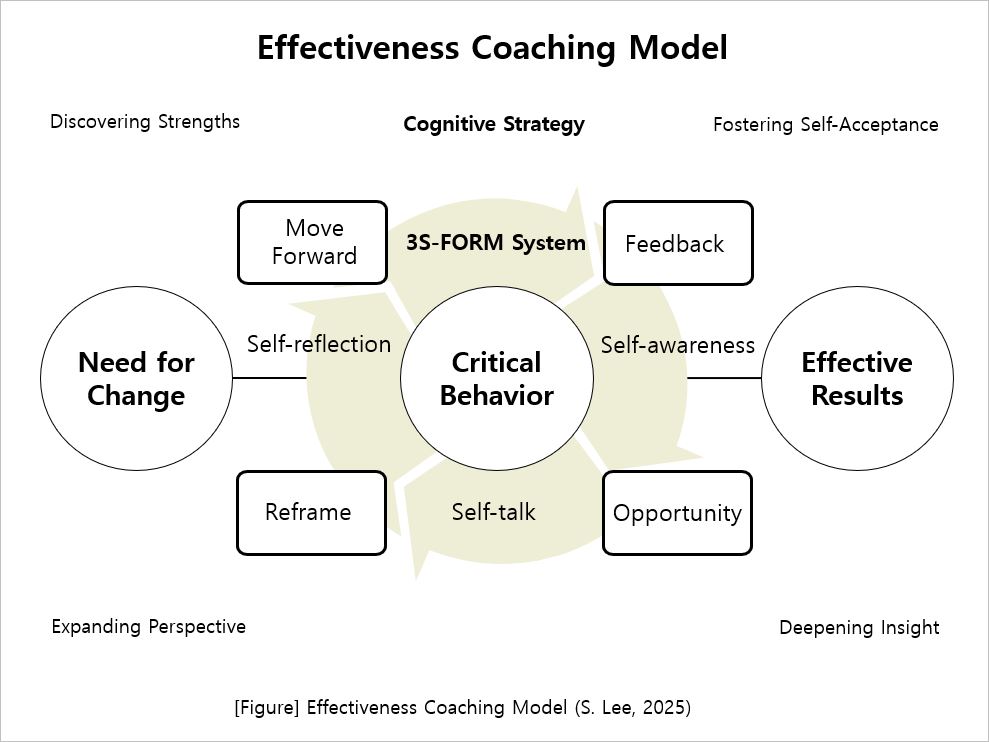
The Effectiveness Coaching Model—particularly models that emphasize cognitive or internal change, such as the 3S-FORM Model—uses a structured process to address these underlying mental models.
1. Diagnosis and Awareness (Identifying the Current Model)
The coaching process begins by helping the client identify their current, often unconscious, mental models. The ECM uses processes like the ABC Framework (Antecedent $\to$ Behavior $\to$ Consequence) to pinpoint the specific thoughts and beliefs (the internal growth engine, or 3S: Self-Awareness, Self-Talk, Self-Reflection) that trigger or reinforce ineffective behaviors.
2. Reframing and Transformation (Challenging the Model)
This is the core of the relationship. The coaching model provides techniques and a safe space to challenge the limiting mental model.
- The "Reframe" stage in processes like the FORM model is explicitly designed to help the client adopt a new, more effective mental model.6 This involves helping them view the situation or themselves from a different, empowering perspective.
- The coach uses cognitive strategies to replace ineffective beliefs with new, effective ones that enhance the possibility of achieving desired results.7
3. Action and Reinforcement (Applying the New Model)
The final stages of the ECM focus on translating the new mental model into concrete action and effective results.
- By adopting a new mental model (e.g., changing "I'm not good at X" to "I can learn and improve at X"), the client gains new options and the will (or motivation) to take action.
- The coaching structure ensures the new mental model is tested through behavioral changes and reinforced by positive outcomes, making the new, more effective mental model permanent.
In summary, the Effectiveness Coaching Model is the methodology that coaches use, while the mental model represents the underlying target—the way the client currently thinks—that must be modified for coaching to be effective.
4. Why Dr. Lee's Methodology(ECM) uses Mental Models Differently
Unlike general coaching frameworks, Dr. Lee treats mental models not as abstract “beliefs,” but as practical, coachable units of meaning that directly connect:
- internal narratives
- behavioral patterns
- developmental drivers
- emotional interpretations
- self-regulatory capacity
- effectiveness outcomes
This creates a dual-engine architecture (3S + FORM) that simultaneously transforms:
- internal drivers (mental models, self-interpretations)
- external behaviors (critical actions toward desired results)
Together, this forms an integrated system for predictable behavioral change.
References
Lee, Sukjae (2006). Develop 18 Core Leadership Competencies. Seoul: Kim & Kim Books.
Lee, Sukjae (2014). Effectiveness Coaching by a Business Psychologist. Seoul: Kim & Kim Books.
Lee, Sukjae (2019). Thought Revolution That Changes My Life. Seoul: Wildbooks.
Lee, Sukjae (2020). Coaching Methodology. Seoul: Korea Coaching Supervision.
Lee, Sukjae (2020). How to Use a Wandering Mind. Seoul: Plan B Design.
Lee, Sukjae (2023). Field-Focused Coaching Psychology. Seoul: Hakjisa.
Lee, Sukjae (2024). Coaching Psychology Class for Boosting Execution. Seoul: Hakjisa.
Lee, Sukjae (2024). Thinking Partner. Gyeonggi: Moa Books.
Lee, Sukjae & Lee, Jongseo (2025). Perspective Shifting. Seoul: Parkyoungstory.