Strength-Based Effectiveness Coaching
Thirteen years ago, I conducted a workshop for the heads of groups at a major domestic company where we diagnosed their leadership, debriefed the results, and established leadership development plans (Lee, S., 2014). At the time, participants in the workshop requested continuous support to implement their leadership development plans. I determined that coaching was the optimal solution, so I designed a coaching program and initially held up to three coaching sessions. My work as a coach began this way.
Developing a Coaching Methodology Essential for Performance Improvement
I found an opportunity to systematically develop my perspective and methods on coaching. A major domestic corporation introduced coaching for the first time to nurture its core talent, and I participated as an external professional coach for over seven years. Participating in coaching for team leaders, executives, and top management, I experienced the process by which individual change in a leader influences team and organizational change. Joining this process of change, I began to explore a coaching methodology that links change with business performance.
My early coaching experiences involved conducting individual coaching, group coaching, or coaching workshops for leaders. The typical coaching goal was the improvement of the leader's leadership competency and performance. Recently, major domestic companies have announced their 'Way,' which embodies their management philosophy and beliefs. I also became interested in organizational change and development while participating in coaching projects to disseminate the 'Way' and internalize it within organizational members through coaching.
The main reason for writing this book is to share the 'coaching methodology that creates desired results through individual and organizational change,' which I developed while working as a professional coach. I completed the first draft of the book in March 2010, titled Coaching Leadership Solved Through Dialogue. Since then, I have refined and structured the coaching procedures, methods, and tools through various coaching cases. In this process, I organically integrated my knowledge as a psychologist, my experience in corporate consulting and coaching, and my expertise in developing diagnostic tools. I compiled the essence of all I know and have experienced and named it 'Effectiveness Coaching'.
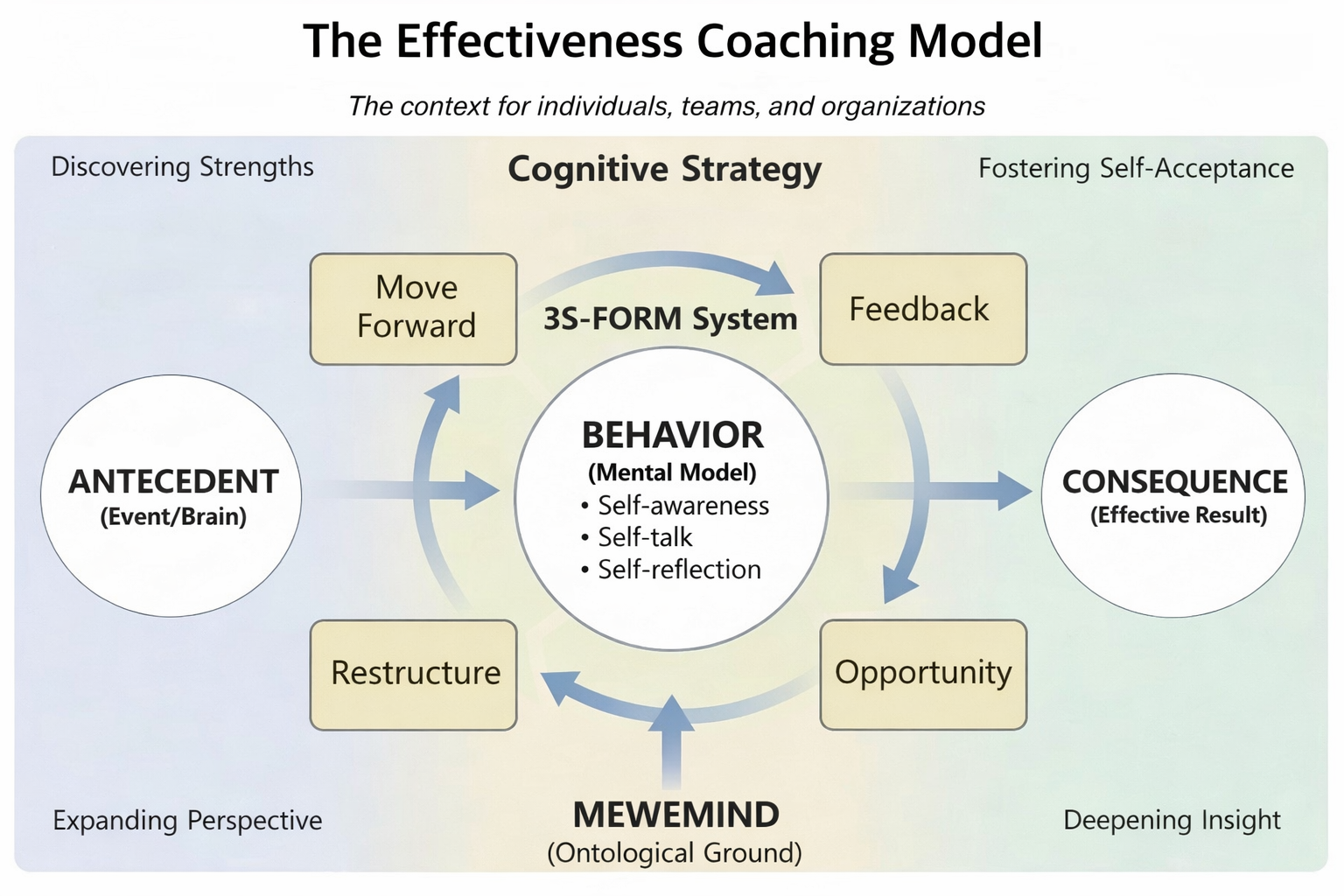
This book introduces two coaching models:
- '3S-FORM Coaching Model': Based on analysis of various coaching theories rooted in psychology and behavioral change theories, literature review on corporate coaching cases, and over 3,000 hours of corporate coaching experience (by International Coach Federation - ICF standards), I developed a 4-stage coaching model that brings about individual change. This model is characterized by a diagnosis-based coaching process with four stages—Feedback, Opportunity Discovery, Reconstruction, and Forward Movement—and three cyclical psychological change principles: Self-Awareness, Self-Talk, and Self-Reflection.
- 'Strength-Based Effectiveness Model': This is the fundamental framework of Effectiveness Coaching. The purpose of coaching is to enhance effectiveness through individual and organizational change. Effectiveness is the degree to which desired results are achieved. To achieve desired results, factors that positively influence effectiveness must be managed in a balanced way. The representative influencing factors are Productivity Factors for creating the desired results and Positivity Factors that constitute a culture and environment suitable for creating those results. All of these are strength factors. The Strength-Based Effectiveness Model is structured by a logical relationship: 'Influencing Factors - Critical Behaviors for Desired Results - Desired Results'.
For the two coaching models to be utilized in corporate settings, supporting tools are necessary. I developed three diagnostic tools to objectively measure the factors influencing effectiveness and analyze the logical relationship for achieving desired results: Effective Leadership Assessment, Team Effectiveness Assessment, and Organizational Effectiveness Assessment. These are all multi-rater assessments and are administered online. Critical behaviors for achieving desired results are derived through these assessments.
Integrated Coaching for Individual, Team, and Organization is the New Path
For a company to create outstanding performance and grow sustainably, individual effectiveness, team effectiveness, and organizational effectiveness must be improved and interconnected. In a rapidly changing global market environment, a stable response strategy lies in the improvement and interlinking of effectiveness at each organizational unit level.
The leaders I met through corporate coaching have started to recognize the importance of Effectiveness Coaching. I gained confidence that I could help individuals and organizations create desired results through Effectiveness Coaching.
Thirteen years after coaching was introduced in South Korea, many companies are accepting coaching as a core competency required for leaders and as a method for talent development. Coaching is included as essential content in competency enhancement training for executives, promotion training for new leaders, and basic training for new employees. The methods for teaching coaching concepts and skills have also diversified, shifting from mainly group education to individual tailored programs for executives and group coaching for mid-level leaders.
However, in the corporate world, coaching is still largely recognized as a technique for improving individual leadership. Although individual coaching, team coaching, and group coaching are utilized in various ways as coaching methods, they are often understood and applied merely as differences in talent development approaches. Activities that integrate coaching with organizational change and development at the team or business unit level are insufficient. Now is the time to expand the scope of coaching utilization from an individual-level developmental approach to a solution that leads change and development for teams and organizations.
A fundamental change is needed in the existing perception and methods of coaching. This book is not a theoretical text on coaching or a collection of coaching cases. To support the fundamental change we need, this book introduces a new coaching methodology based on literature review and field experience, which helps individuals, teams, and organizations achieve desired results, making it easy to understand through coaching examples.
Coaching Design Determines the Success of Coaching
Changing a leader's thoughts and behaviors is not merely about finding answers to that individual's concerns or immediate problems. Their small changes affect stakeholders and influence the team's and the company's business performance. Therefore, the coaching design to bring about changes in a leader's thoughts and behaviors must be carried out from a systemic, organizational perspective, going beyond individual-level demands.
Coaching design consists of a continuous and structured coaching dialogue process suitable for bringing about changes in thought and behavior. The first stage of coaching design is goal setting. The clearer the coaching goal, the more detailed the coaching design. The next stage involves establishing specific procedures and methods to achieve the set coaching goal. The changes in thought and behavior necessary to achieve the goal are made concrete. The more specific the content of the change derived, the higher the likelihood of successful change and the achievement of the coaching goal.
Coaching procedures and methods are adjusted according to the duration and budget available for conducting the coaching. The final stage involves evaluating the effectiveness of the coaching. I keenly realized the importance of coaching design while conducting coaching for leaders in the corporate setting. Designing coaching is as exciting as architectural design for building a house.
To design effective coaching, experience with various coaching cases is important, and an understanding of experimental design and social science research methodology is required. While corporate coaching cannot be conducted in a controlled situation like a laboratory, a quasi-experimental design can be applied. The experimental design, quasi-experimental design, and social science research methodology I learned while growing as a psychologist have been a great help in conceptualizing coaching design.
The reader will encounter various coaching designs in this book. This is because the design differs depending on the coaching subject. As the coaching subject grows from an individual to a team and an organization, group dynamics and culture are considered more. Furthermore, the coaching process changes depending on whether the coaching goal is to improve competencies and skills, such as a leader's leadership development, or to improve performance. This book only presents standard coaching designs for improving individual, team, and organizational effectiveness.
Expecting Field Application and Diffusion of Effectiveness Coaching
This book is divided into three parts.
- Part 1 introduces Strength-Based Effectiveness Coaching. It presents the basic conditions for an organization to create outstanding performance, introduces the main elements of the Strength-Based Effectiveness Model, and highlights the key features of Effectiveness Coaching that differentiate it from other coaching techniques. It then introduces the 3S-FORM Coaching Model and coaching cases for each coaching stage. The content of the coaching cases is real, but the names of the main characters are pseudonyms, and some job duties have been modified to protect privacy and personal information. Through the Strength-Based Effectiveness Model and the 4-stage coaching model for individual change, the reader can understand the methodology of Effectiveness Coaching and learn the knowledge and skills for field application.
- Chapter 1 focuses on individual effectiveness in terms of leadership, addressing coaching skills that balance the core competency groups constituting leadership: cognitive competency, interpersonal competency, and strategic management competency.
- Chapter 2 primarily presents methods and strategies for coaching change points necessary for team members to transition from individual contributors to team contributors to enhance team effectiveness.
- Chapter 3 addresses organizational effectiveness in terms of strategy execution through employee engagement.
- Part 2 presents coaching methods for enhancing individual effectiveness, team effectiveness, and organizational effectiveness in companies, divided into three chapters. In each chapter, the coaching model, coaching design, and coaching skills are commonly addressed to help the reader easily understand Effectiveness Coaching. I emphasize diagnosis-based coaching. The effect of immersion is greater, and the need for self-change is easily realized when starting the coaching dialogue by objectively looking at oneself. Therefore, tools for diagnosing each type of effectiveness and how to utilize them in coaching are introduced.
- Part 3 introduces some of the coaching skill tools used in Effectiveness Coaching. When coaching is focused on behavioral change, methods for finding change points, overcoming self-limitations for successful change, and coaching techniques and tools to drive behavioral change are detailed.
I hope that the methodology of Effectiveness Coaching will be helpful to professional coaches active in the field, in-house coaches within companies, leaders who coach their employees, talent development managers, and prospective coaches preparing to grow as coaches. Furthermore, the coaching approach to bring about individual change will be beneficial for general readers interested in self-management and self-development in setting goals and enhancing execution ability.
In this book, while introducing Effectiveness Coaching, I have added concise explanations of selected key concepts and theories from psychology to help the reader easily understand the psychological concepts and related theories. Coaching skills or approaches can be reinterpreted based on psychological theories. As the first person in South Korea to establish and lecture a graduate course in Coaching Psychology, I explored relevant psychological theories as a foundation for coaching to develop as an academic discipline. I am also integratively researching coaching theory and practice while working as a professional coach in corporate settings. This book is the second result created during that journey. I plan to continue empirical field research on the concepts and logic constituting Effectiveness Coaching.
I sincerely hope this book helps readers broaden their perspective on coaching and contribute to the diffusion of coaching in the field.
Source: Lee, Sukjae (2014). Management Psychologist's Effectiveness Coaching. Seoul: Kim & Kim Books.
 |