What is Effectiveness Coaching Model?
Sukjae Lee Ph.D.
Creator of the Effectiveness Coaching Methodology
2025. 11. 30
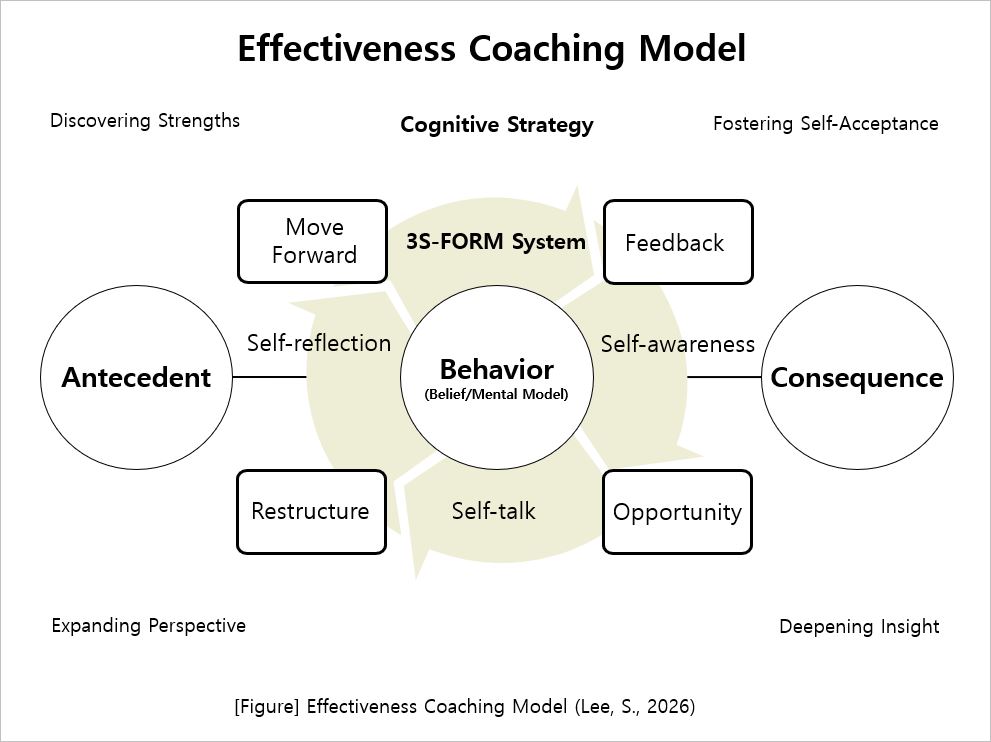
I. Integrated Model: ABC-3S-FORM
The integrated framework works by:
- Using the ABC Framework for a Behavioral Analysis of a specific challenge.
- Utilizing the 3S (Self-Awareness, Self-Talk, Self-Reflection) as the Internal Growth Engine to drive change in the coachee's internal beliefs and actions.
- Employing the FORM (Feedback, Opportunity, Restructure, Move forward) as the Coaching Process structure, which guides the conversation toward action.
- Enhancing all of this with the Four Cognitive Strategies to strengthen the coachee's internal capacity for change.
1. The Core Behavioral Analysis: ABC Framework
The ABC framework connects an observable situation to a result, which then directs the coaching focus.
- A: Antecedent / Need for Change (Trigger): What happened before the behavior?
- Coaching Goal: Clarify the specific situation, context, or trigger that leads to the problem behavior. This defines the Need for Change.
- B: Critical Behavior (Action/Belief/Mental Model): The specific, observable action or lack of action the client takes.
- Coaching Goal: Precisely define the behavior that needs to be modified or acquired. This is the Critical Behavior.
- C: Effective Results (Consequence): The outcome or result that follows the behavior.
- Coaching Goal: Analyze the current (often ineffective) consequences and define the desired Effective Results.
2. The Central Framework: 3S-FORM
The 3S-FORM model defines the respective roles for the coachee (3S) and the coach (FORM), ensuring change is driven internally by the client but structured externally by the coach.
3S: The Coachee's Inner Growth Engine (Internal Drivers)
These are the cognitive processes the coachee must actively engage in, often supported by the coach's use of the Four Cognitive Strategies.
- Self-Awareness: Objectively understanding one's own strengths, weaknesses, emotions, and behavioral patterns (e.g., how their current Beliefs influence B and C in the ABC model).
- Self-Talk: The internal dialogue that influences mindset, motivation, and behavior. This is a critical point for replacing irrational beliefs with rational ones.
- Self-Reflection: The process of critically evaluating past and present experiences (A-B-C cycles) to learn and plan improvements for the future.
FORM: The Coach's Process Framework (External Structure)
This provides the structure for the coaching conversation.
- Feedback: Aligning on the desired Effective Results (C) and the Need for Change (A). What is the goal?
- Oppotunity: Exploring potential strategies, new skills, and choices for the Critical Behavior (B). What can you do differently?
- Restructure: Shifting old perspective, newly assessing the current situation, and identifying internal (3S-driven) and external resources. What is the situation, and what do you have to work with?
- Move forward: Developing concrete next steps and committing to implementing the new Critical Behavior (B) to achieve the Effective Results (C).
3. The Enablers: Four Cognitive Strategies
Your four cognitive strategies—Discovering Strengths, Expanding Perspective, Deepening Insight, and Fostering Self-Acceptance—act as the enabling activities a coach uses throughout the FORM process to activate and enhance the coachee's 3S (Self-Awareness, Self-Talk, Self-Reflection).
| Cognitive Strategy | Primary Effect on 3S & ABC |
| Discovering Strengths | Enhances Self-Awareness and positive Self-Talk by identifying existing resources that can be used in the new Critical Behavior (B). |
| Expanding Perspective | Enhances Self-Reflection and challenges limiting Self-Talk by exploring alternative views of the Antecedent (A) or the Consequence (C). |
| Deepening Insight | Promotes profound Self-Awareness and Self-Reflection into the underlying beliefs and motivations linking A B C. |
| Fostering Self-Acceptance | Supports healthy Self-Talk by neutralizing self-judgment related to past consequences, freeing the coachee to commit to new actions (M in FORM). |
II. Unified Coaching Flow
The coaching process flows cyclically:
- Diagnosis: Use ABC to identify the current cycle (Trigger Behavior Result).
- Goal Setting: Set a goal for the new desired Effective Results (C).
- Coaching Session (FORM): Structure the session using FORM.
- Throughout FORM, the coach strategically deploys the Four Cognitive Strategies to activate the coachee's 3S (Inner Growth Engine).
- Behavioral Change: The activated 3S drives the coachee to define and implement the new Critical Behavior (B).
- Evaluation: Re-evaluate the new cycle and continue the process until the goal is achieved.
References
Lee, Sukjae (2006). Develop 18 Core Leadership Competencies. Seoul: Kim & Kim Books.
Lee, Sukjae (2014). Effectiveness Coaching by a Business Psychologist. Seoul: Kim & Kim Books.
Lee, Sukjae (2019). Thought Revolution That Changes My Life. Seoul: Wildbooks.
Lee, Sukjae (2020). Coaching Methodology. Seoul: Korea Coaching Supervision.
Lee, Sukjae (2020). How to Use a Wandering Mind. Seoul: Plan B Design.
Lee, Sukjae (2023). Field-Focused Coaching Psychology. Seoul: Hakjisa.
Lee, Sukjae (2024). Coaching Psychology Class for Boosting Execution. Seoul: Hakjisa.
Lee, Sukjae (2024). Thinking Partner. Gyeonggi: Moa Books.
Lee, Sukjae & Lee, Jongseo (2025). Perspective Shifting. Seoul: Parkyoungstory.